The Heart of the Rainforest
The air in Tanjung Puting National Park, Indonesia, feels alive.
It hums with the rhythm of cicadas and the whisper of leaves. Shafts of sunlight pierce the canopy, scattering golden dust across a forest that’s been breathing for millions of years.
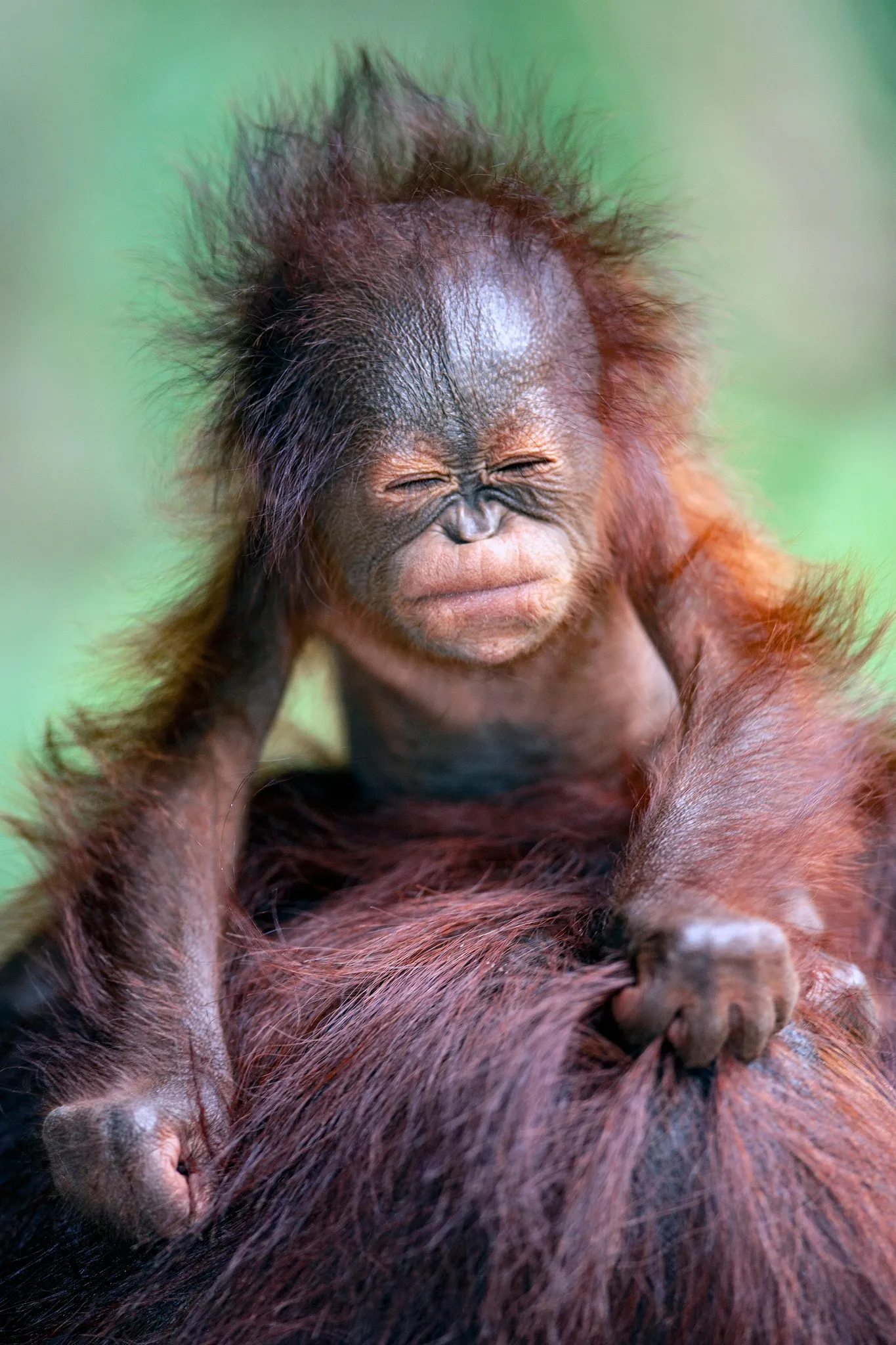
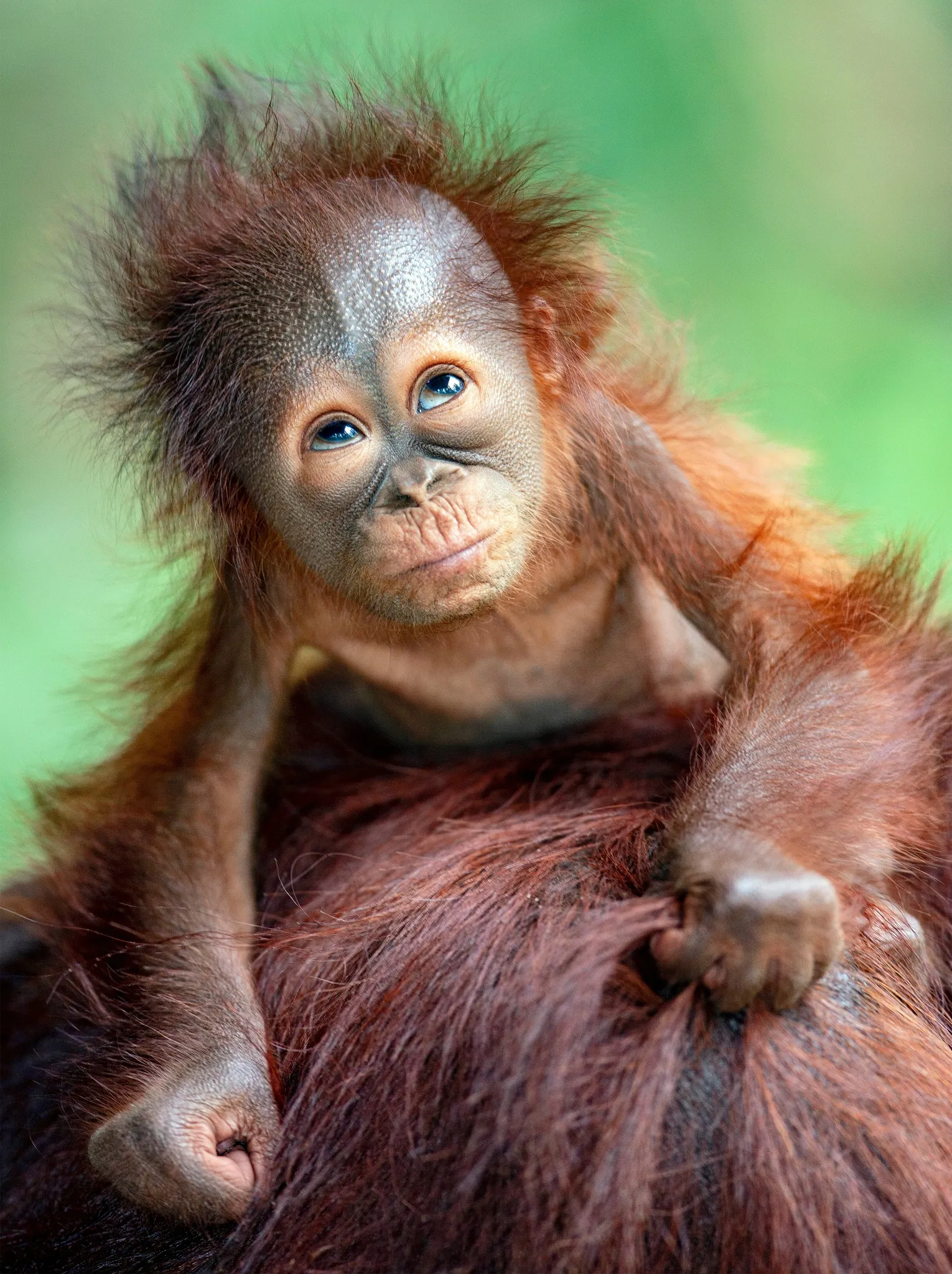
And somewhere, high in the tangled embrace of fig and kapok trees, a baby orangutan clings tightly to his mother’s chest — his tiny fingers curling into her deep orange fur.
His name, given by rangers who’ve watched him grow, is Bumi, meaning Earth.
He’s only seven months old — soft, round, endlessly curious — and, as wildlife photographer Brian Matthews would later say, “the most expressive little face I’ve ever seen.”
A Morning Like No Other
That morning, Brian sat quietly on a wooden boardwalk deep in the forest, his camera steady on his lap. He had been waiting for hours, hoping to catch a glimpse of the orangutans that call this national park home.
Suddenly, a rustle.
Then — a low creak of branches.
Out of the green maze, a large female orangutan appeared, moving with surprising grace for her size. Her reddish fur glowed in the sunlight, and clinging to her belly like a patch of living fire was Bumi.
Brian held his breath. He had seen orangutans before — but this one, this pair, had something special.
The mother stopped on a low branch, settling comfortably. Bumi peeked out from beneath her arm, blinking wide amber eyes at the world.
And then — he began his performance.
The Faces That Stole the World’s Heart
First came the grumpy grimace.
Bumi pursed his lips, furrowed his tiny brows, and looked up at his mother with pure baby indignation.
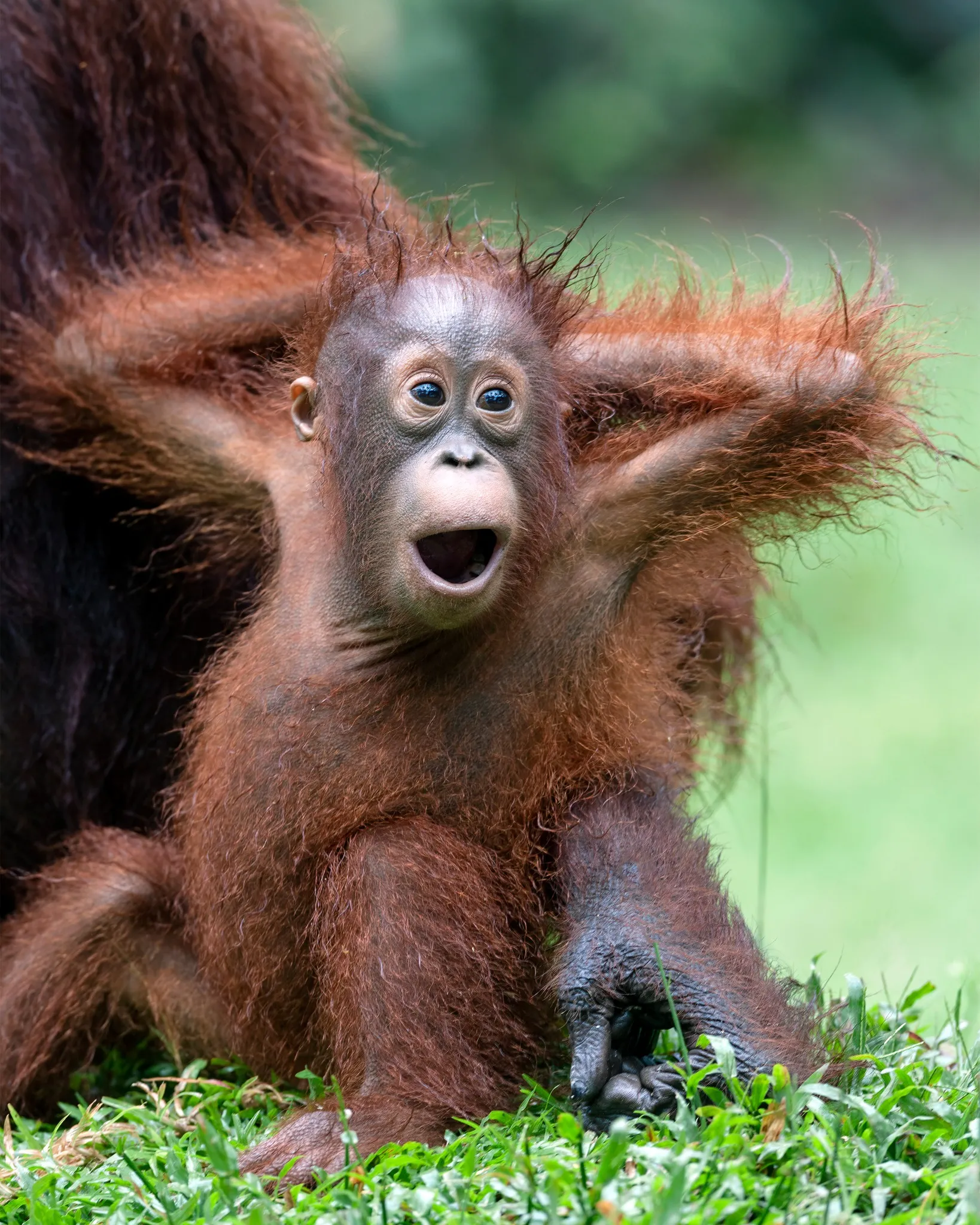
Next came the wide-eyed stare — comically serious, as though the world’s smallest philosopher had just realized the forest was enormous.
Then, for his grand finale, he grabbed a handful of his mother’s long hair… and promptly began chewing on it.
The mother sighed — an unmistakable sound of parental resignation — and simply let him.
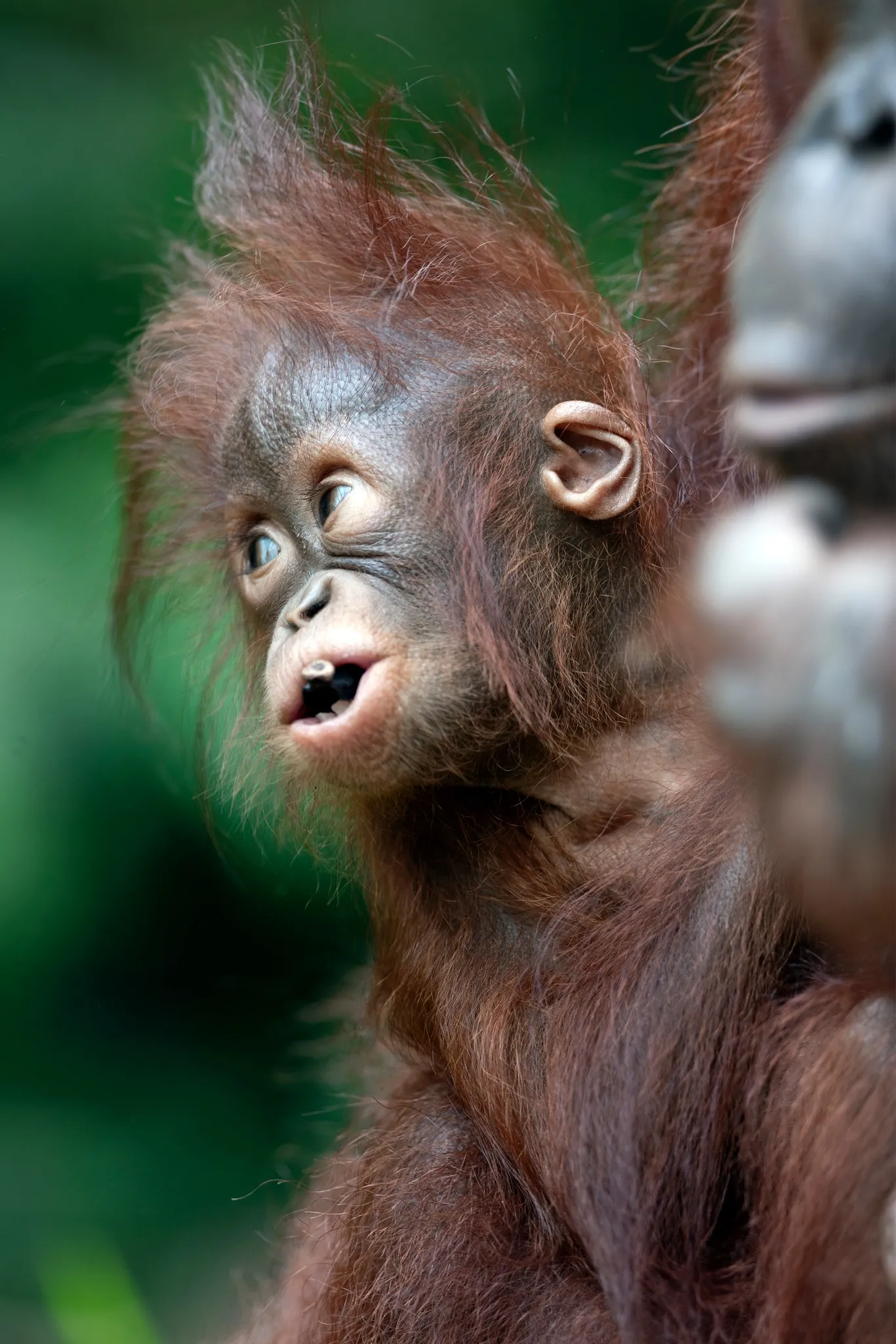
Brian couldn’t help but chuckle quietly behind his camera. For the next twenty minutes, he captured every moment — the yawns, the frowns, the laughter written in fur and light.
Later, one of the photos — Bumi with honey-colored eyes peeking through his mother’s arm — would go viral. People around the world called him “the funniest baby in the jungle.”
But behind the laughter lay something far deeper.
Growing Up Orangutan
In the wild, an orangutan mother and her baby share one of the strongest bonds in the animal kingdom.
Bumi will stay with his mother for up to eight years — learning how to climb, find food, build nests, and navigate the dangers of the rainforest.
Every day, she teaches him through touch and example — how to peel bark to find termites, how to taste test fruit for ripeness, how to weave a bed from branches before sunset.
Each lesson is a thread in the delicate web of survival.
Orangutans grow slowly — almost human-like in their childhood. Their intelligence, their curiosity, and even their sense of humor mirror ours in ways that feel both magical and haunting.
And just like humans, they form distinct personalities.
Some are shy.
Some are playful.
And some — like Bumi — seem born to make the world smile.
A Life on the Edge
But behind that smile, the forest tells a different story.
Every year, the orangutans’ home grows smaller.
Deforestation for palm oil plantations and illegal logging have stripped away vast stretches of rainforest. In some areas, the silence of chainsaws has replaced the song of birds.
In the last century, orangutan populations have dropped by over 80%.
The species is now listed as Critically Endangered.
So when a baby like Bumi is born in the wild — alive, healthy, safe — it’s more than just another birth.
It’s a sign of hope.
Each new life is proof that the forest still breathes, that conservation works, that maybe, just maybe, there’s still time to protect what remains.
Behind the Lens
Brian Matthews has been photographing wildlife for more than 20 years. He’s seen lions hunt, elephants mourn, and snow leopards disappear into fog.
But this — this was different.
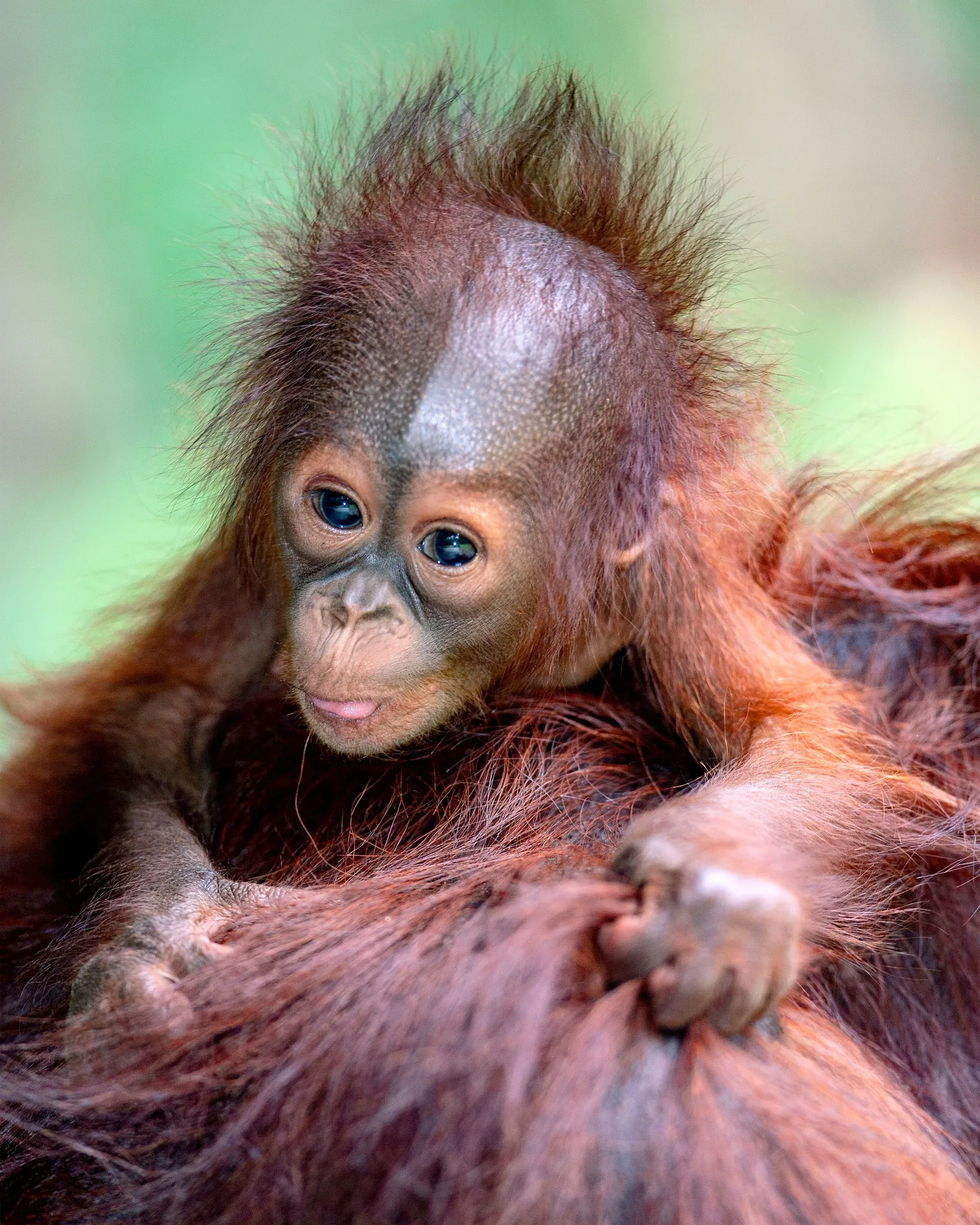
“When I saw that baby orangutan looking up at me,” he said, “I realized I wasn’t just capturing an animal. I was capturing a piece of ourselves.”
He described the moment when Bumi’s mother met his gaze. Her expression wasn’t fear — it was awareness.
She seemed to know he meant no harm.
For a few quiet minutes, two species — human and orangutan — simply watched each other, breathing the same air beneath the same sky.
And then, with her baby clinging close, she turned and melted back into the green shadows.
7. The Photo That Spoke a Thousand Words
When Brian posted the photos online, the world fell in love.
Comments poured in from every corner of the globe:
“That little face made my day.”
“How can something so pure be endangered?”
“We have to protect them.”
Wildlife organizations began sharing Bumi’s story as a symbol of conservation — proof that emotion could be the most powerful call to action.
Because when people care, they protect.
Lessons from the Canopy
Weeks later, the rangers spotted Bumi again — now a little bolder, a little more independent. He was learning to climb higher, his grip surer, his gaze curious as ever.
The forest echoed with his tiny whoops and playful chatter.
His mother watched from a nearby tree, patient and proud. She knew he’d one day swing through these branches on his own.
But for now, he still reached for her hand.
Because even in the heart of the jungle, love is universal.
The Message of Bumi
Bumi’s story reminds us that protecting wildlife isn’t just about saving animals.
It’s about preserving the laughter, the connections, and the living miracles that remind us what it means to share this planet.
As conservationist Dr. Maria Setiawan put it:
“When you look into an orangutan’s eyes, you’re not looking at an ‘animal.’ You’re looking at a cousin, a teacher, a reflection of ourselves.”
And somewhere in Tanjung Puting, as the sun sets through a curtain of vines, a small orange face peeks out from his mother’s arms — eyes bright, mouth sticky with curiosity, heart full of wonder.
He doesn’t know he’s famous.
He doesn’t know he’s endangered.
He only knows the warmth of his mother, the taste of fruit, and the endless mystery of the forest that raised him.
And maybe, that’s the purest kind of hope of all. 🌿🧡