The call came just after sunrise — a distressed elephant had been spotted near Katombora, close to the Zimbabwe–Botswana border.
The voice on the radio carried urgency: “It’s a young one… she’s stuck deep in the mud by the riverbank.”
For those of us who have worked in wildlife rescue, there’s a certain tone that instantly tightens your chest — the kind that says time is running out. We knew this would be one of those mornings.

The Lonely Giant
The report suggested that the herd had moved on, likely during the night. It’s something that happens more often than people realize. When a young elephant gets trapped, the herd will try desperately to help — using trunks, tusks, even their feet — but mud can be merciless.
And when dawn comes, survival instinct takes over. The herd moves on. The trapped one is left behind.
We packed our gear — ropes, straps, tranquilizers, first aid kits — and set off toward Katombora. Our small team of three was joined by three Zimparks rangers, men who know this land like the lines on their hands. The Zambezi flowed strong that morning, swollen by recent rains. If the elephant had been stuck all night, exhaustion and dehydration would already be setting in.
The sun climbed higher as we navigated through thick brush and uneven ground, the tracks of the herd still fresh. Every few minutes, one of us would stop to listen — ears tuned to the faintest cry, the telltale trumpet of distress.
Then, we heard it.
A low, muffled rumble — weak but alive.

Trapped by the Zambezi
When we reached the riverbank, the sight before us stopped us cold.
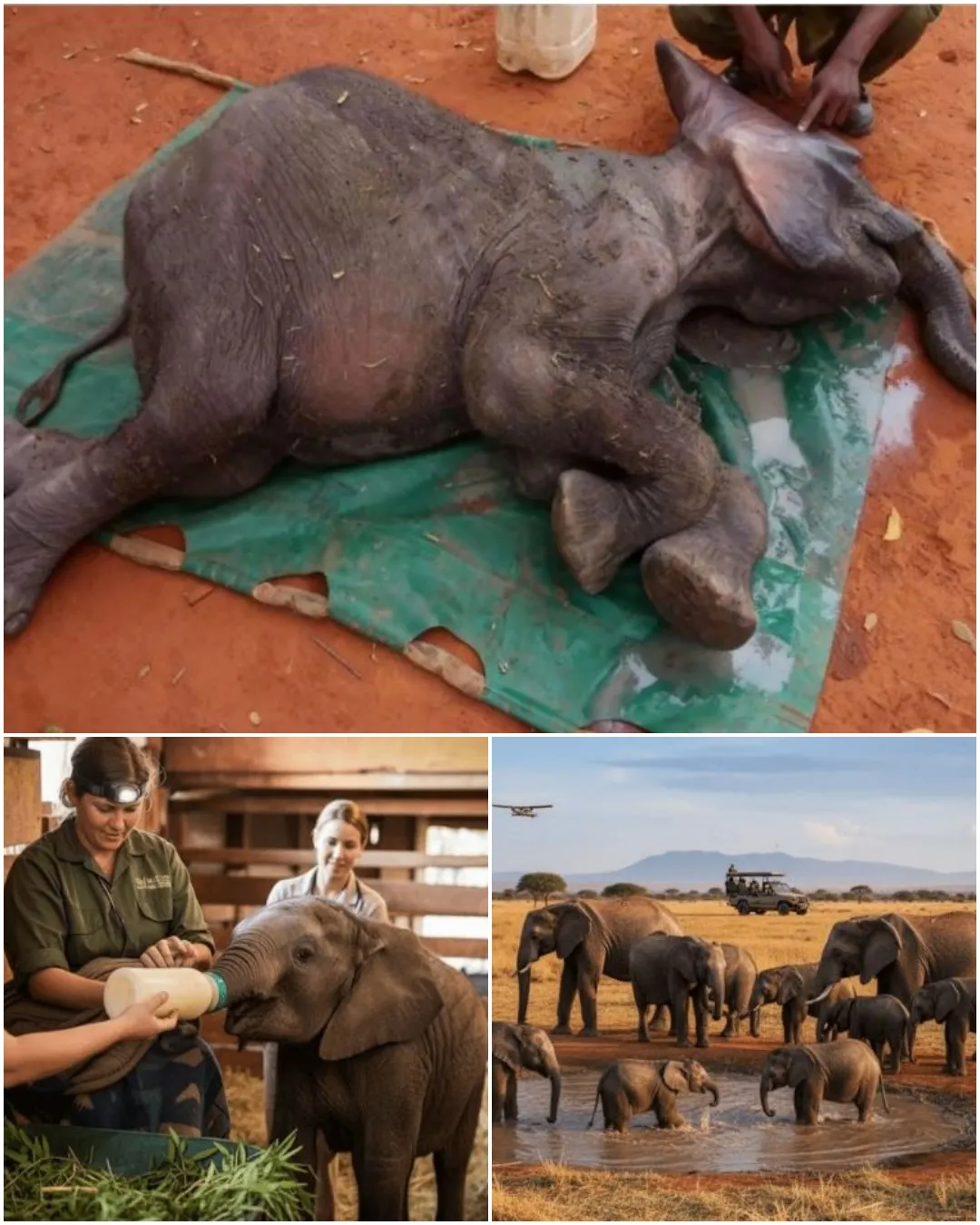
There she was — a young female elephant, perhaps four or five years old, half-buried in mud. Her body trembled with every breath, her trunk weakly curling toward us, as if pleading for help. Only her back, head, and part of her sides were visible. The rest was trapped in a thick, unforgiving layer of mud.
The air was heavy with the smell of damp earth and desperation. Around her, the marks of her struggle told the story — deep grooves in the mud where she had tried again and again to pull herself free.
She had likely been there since the previous night.
If we didn’t act fast, she would not make it through another day.

A Plan and a Prayer
We moved quickly. The vet prepared a tranquilizer dart while the rangers cleared a safe area around her. The goal was to keep her calm — stress and panic could make her heart rate spike dangerously.
The dart hit cleanly, and within minutes, her body relaxed. Her breathing steadied, and her eyes fluttered half-shut. It was our cue to move in.
The mud sucked at our boots as we waded closer, the heat already rising off the river. Together, we attached two heavy straps: one looped gently under her tail, the other beneath her chin. Each strap connected to an electric winch secured to our vehicle.
She was facing forward — a stroke of luck. That meant we could pull her straight out without twisting her body or risking injury.
The winch hummed to life, slow and steady. The mud resisted at first, clinging greedily to her weight. Then, with a wet, heavy sound, her body began to rise inch by inch.
We cheered quietly under our breath, hands gripping the straps, eyes locked on her. The riverbank turned into a dance of coordination — one ranger managing the winch speed, another keeping her airway clear, the rest of us supporting her massive weight as she finally slid free from the pit that had held her captive.

Out of the Mud, Into the Light
When she was finally clear, we could see the full extent of her ordeal. Her body was covered in thick, dark mud, streaked with sweat and scratches. But she was alive — breathing steadily, her trunk twitching slightly as if testing the air.
We worked quickly to clean her and check for injuries. Apart from exhaustion and muscle stiffness, she seemed unharmed. The mud had acted as both a prison and a strange kind of protection — keeping her skin cool and shielding her from the worst of the heat.
As we finished cleaning, the vet prepared to reverse the tranquilizer. This is always a tense moment — waiting for life to return in full force.
We stepped back, our boots sinking into the damp soil, hearts pounding as the drug began to wear off.
The Moment She Stood
Her ears flicked first, then her trunk moved. Slowly, she lifted her head. Her eyes opened — wide, alert, and full of confusion.
She shifted her weight, her legs trembling beneath her. For a few seconds, she struggled to rise — the muscles stiff after hours of immobility. But then, with a deep, guttural rumble, she pushed herself up, her massive frame rising higher and higher until she stood tall against the river’s edge.
We stood there in silence, hardly breathing. She was free.
At first, her steps were unsteady, her body swaying as if learning to walk again. But within minutes, strength returned. She lifted her trunk, sniffed the air, and took a few firm steps forward — each one surer than the last.
Then, in a moment that made all the mud, heat, and exhaustion worth it, she crossed the road ahead of us — her gait steady, her spirit unbroken.

A Hopeful Goodbye
As she disappeared into the bush, one of the rangers smiled quietly.
“She’ll find her herd,” he said. “They never forget their own.”
We stood for a while longer, watching the trees where she had vanished. The sound of the Zambezi carried through the air — calm again, as if the river itself sighed in relief.
We gathered our gear, our clothes heavy with mud, our hearts light with gratitude. Every rescue feels like a small miracle — a reminder that compassion still has the power to change the story, even in the wild.
That young elephant will always be more than just another rescue to us. She will be the one who fought the mud, endured the night, and walked again into freedom.
And somewhere, as the day faded over the borderlands of Zimbabwe and Botswana, we imagined her trumpet echoing through the trees — a sound of life, of strength, of survival.
A Note of Thanks
This rescue wouldn’t have been possible without the teamwork and dedication of Zimparks rangers, who worked side by side with us in harsh conditions. Their quick response, courage, and steady professionalism made all the difference.
It’s easy to forget how much effort goes into saving a single life in the wild — how much trust, precision, and heart it takes. But for us, and for her, it was worth every moment.
Because every life — no matter how small or silent — deserves the chance to rise again.