The African savannah is a place ruled by instinct.
Every movement, every heartbeat, every decision — all guided by the raw, ancient rhythm of survival.
Predator and prey exist in a delicate dance, one that has endured since the beginning of time.
But on one extraordinary afternoon, the timeless order of the wild was quietly rewritten.
It began as so many stories of the wilderness do — beneath the golden stretch of the sun, where the tall grass shimmered like liquid fire.
A lion, magnificent and proud, lay half-hidden in the shadows.
His mane, dark as burnt honey, framed eyes that watched the open plain with quiet calculation.
He was a king, not by title, but by the silent command that radiated from his every movement.
Nearby, a herd of antelope grazed cautiously, their ears flicking at the faint whisper of the wind.
The lion’s muscles tightened.
It was the stillness before the storm — that charged pause where life and death hang in perfect balance.
Then, in an instant, the savannah erupted.
Dust flew.
The herd scattered.
The lion surged forward, power and grace entwined in every stride.
The hunt had begun.
But fate, it seemed, had a different story to tell that day.
As the lion gave chase, a small shape stumbled into his path — a young antelope calf, barely old enough to stand.
Its legs wobbled beneath it as it tried to flee, but it was no match for the predator’s speed.
In seconds, the great lion stood over it, the shadow of his mane falling across the trembling creature.
The calf froze, eyes wide, chest heaving.
The air went still.
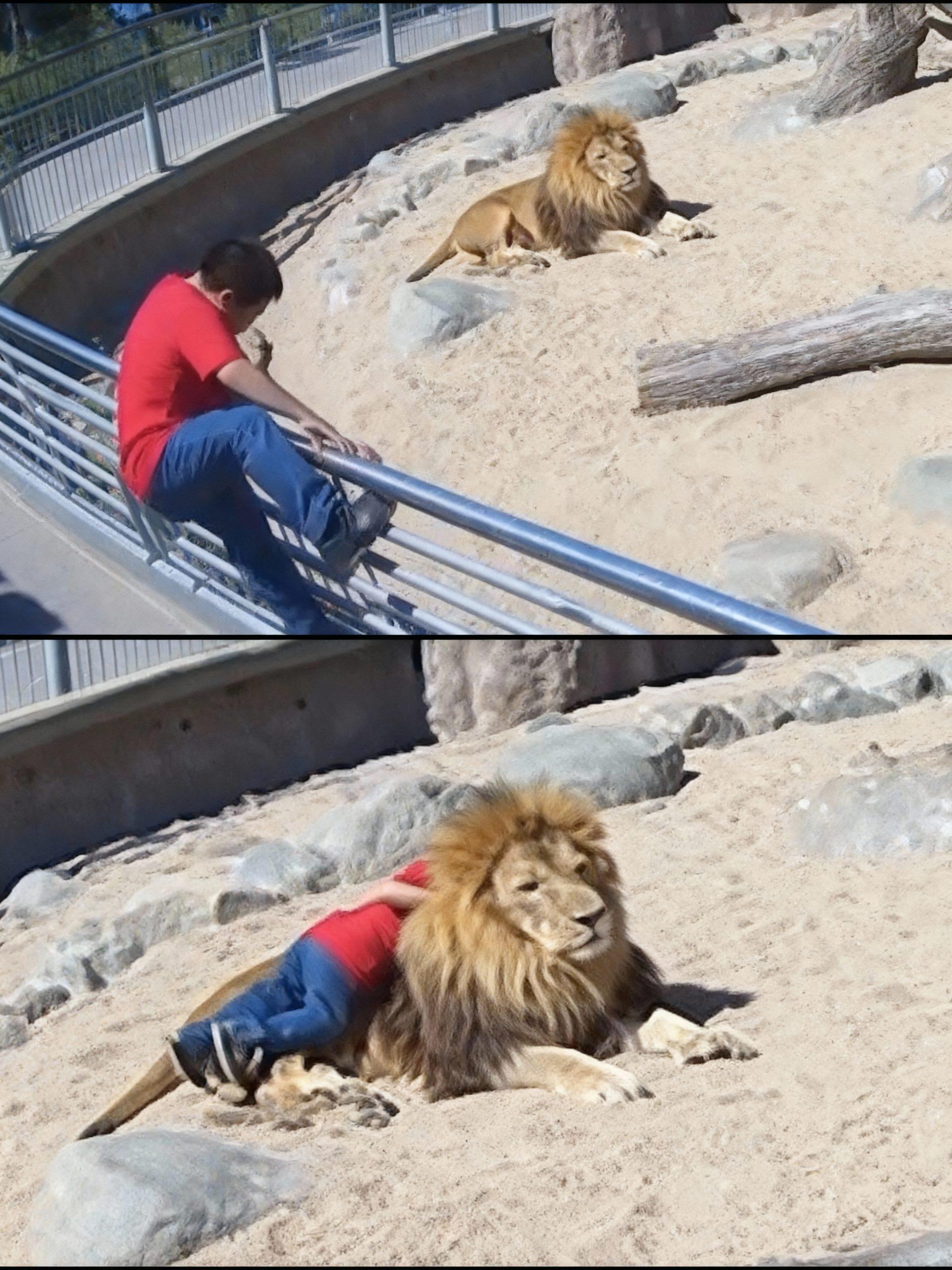
What happened next would leave even the seasoned rangers speechless.
The lion did not strike.
He simply stood there, his golden eyes locked onto the fragile life before him.
The calf bleated softly — a sound of confusion, of terror.
But instead of lunging, the lion lowered his head.
He sniffed the small creature, his breath stirring the dust, and then… he stepped back.
The calf blinked, uncertain.
It was as if the rules of the world had momentarily been suspended.
The lion’s tail swished once, slowly, not in agitation but in something deeper — hesitation, perhaps even thought.
He sat down, his massive frame folding with deliberate gentleness.
Minutes passed.
The calf did not move, and neither did the lion.
They simply regarded each other — predator and prey, ancient enemies, sharing a silent understanding.
From a distance, a wildlife photographer named Elena watched through her lens, frozen in disbelief.
She had followed this lion for months, documenting his hunts, his scars, his reign over this stretch of wilderness.
She knew his power, his ferocity — and yet, before her eyes, he was transformed.
She whispered into her recorder, “He’s… sparing it. He’s letting it live.”
Eventually, the calf stumbled to its feet and began to back away, step by trembling step.
The lion watched, but made no move to follow.
And then, in one fluid motion, he turned — not toward the fleeing calf, but toward the horizon.
He walked away.
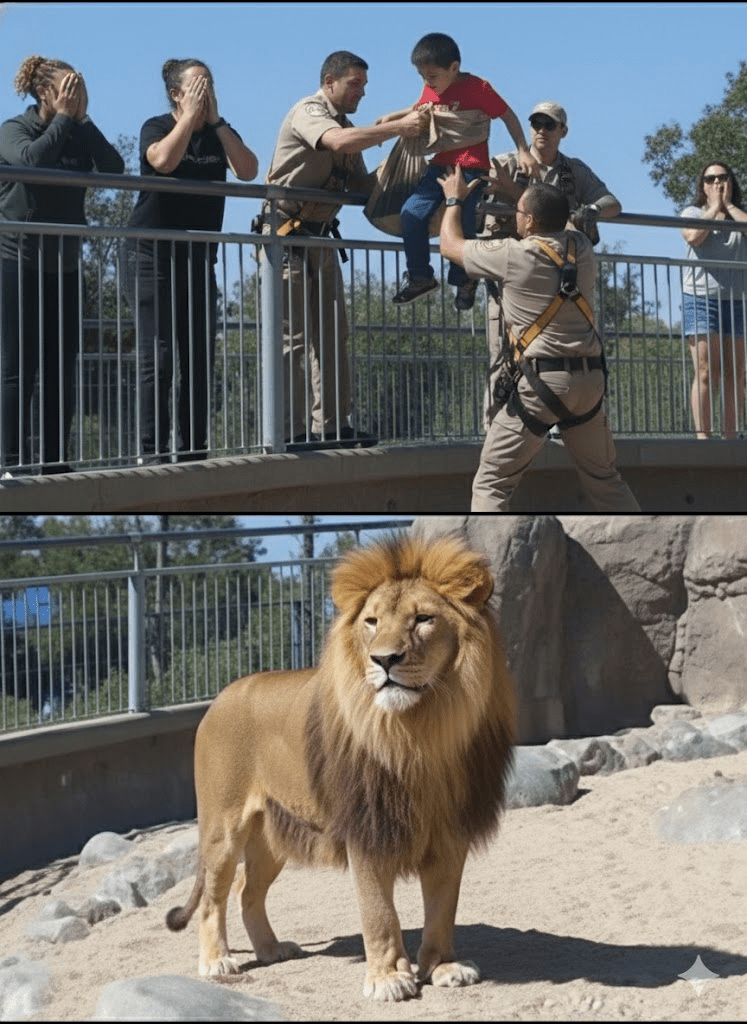
It was a moment so fleeting and yet so profound that Elena could hardly breathe.
She lowered her camera, tears welling up as she whispered, “Compassion. In the wild.”
Over the following days, word of the encounter spread through conservation circles like wildfire.
Scientists debated its meaning.
Some called it anomaly; others called it instinct disrupted by curiosity.
But to those who witnessed it, it was something else entirely — a glimpse of mercy in its purest form.
Perhaps the lion, sated from an earlier hunt, had no need to kill.
Perhaps some deep, unexplainable spark of empathy had stirred within him.
Whatever the reason, the effect was undeniable.
For that brief, miraculous moment, nature itself seemed to pause and reconsider.
Elena later revisited the area, hoping to see the lion again.
When she found him days later, he was resting beneath an acacia tree, his mane moving gently with the wind.
Nearby, his pride lounged in the shade, cubs tumbling playfully over one another.
Life had returned to its usual rhythm — but Elena couldn’t shake the memory of what she’d seen.
“He could have ended a life that day,” she wrote in her journal.
“But instead, he reminded me that even in the wildest heart, there can be stillness. Even in the fiercest creature, there can be grace.”
Her photograph of the encounter would go on to become one of the most powerful wildlife images ever captured — not for its drama, but for its serenity.
In it, the lion sits in sunlight, gazing toward the horizon, his posture regal yet peaceful.
There is no blood, no roar, only quiet dignity — a king who chose mercy over might.
The image sparked conversations across the globe.
Teachers shared it with students to illustrate empathy.
Environmentalists used it to remind people that animals, too, feel, decide, and connect in ways we are only beginning to understand.
And for many, it became a symbol of hope — a reminder that compassion is not confined to humanity alone.
As years passed, the lion’s legacy lived on in the stories told about him.
He was no longer just a predator of the plains; he was the lion who spared a life.
And perhaps, in that act, he did something far greater than the hunt ever could — he reminded the world that mercy is strength in its purest form.
When Elena was later asked what she thought truly happened that day, she smiled softly and said:
“I think for a moment, instinct stepped aside, and something greater took its place — awareness. He saw himself in that calf, just as we might see ourselves in others. And in that instant, he chose peace.”
The savannah remains unchanged — life and death continue their endless cycle.
But somewhere in the vast expanse of grass and light, a story lingers.
A story of a lion who, for one brief moment, listened not to the roar of instinct… but to the whisper of compassion.