The morning sun had barely risen above the misty treetops of Lampang province when a quiet miracle unfolded — one that bridged twelve years, a wild jungle, and the unspoken bond between a man and an elephant.
Dr. Pattarapol Maneeon, a Thai veterinarian with the Department of National Parks, Wildlife, and Plant Conservation, was on routine patrol when he heard it — a deep, resonant rumble carried on the wind. It was a sound both powerful and strangely familiar, one that stirred something deep within his memory.
He stopped walking. “Plai Thang?” he called softly, his voice tentative, uncertain.
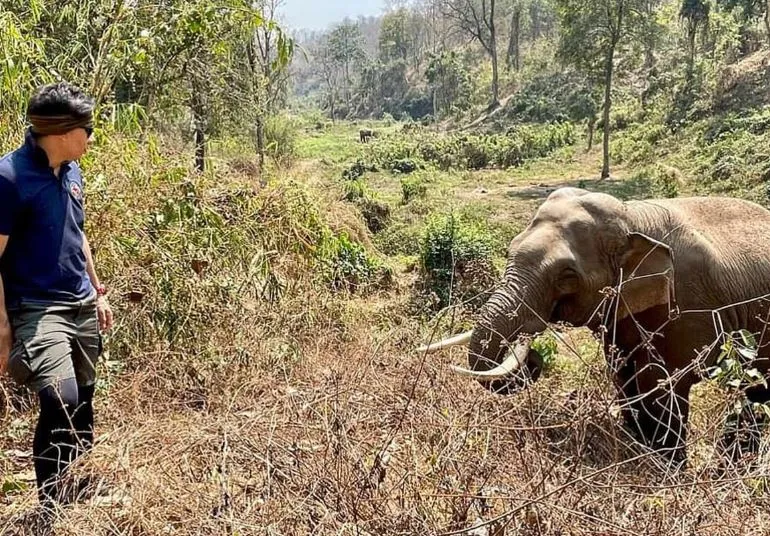
From the forest edge, a massive shape emerged — an adult bull elephant, his ears fanning gently, his eyes calm but alert. The man and the elephant stood facing each other, silent but aware.
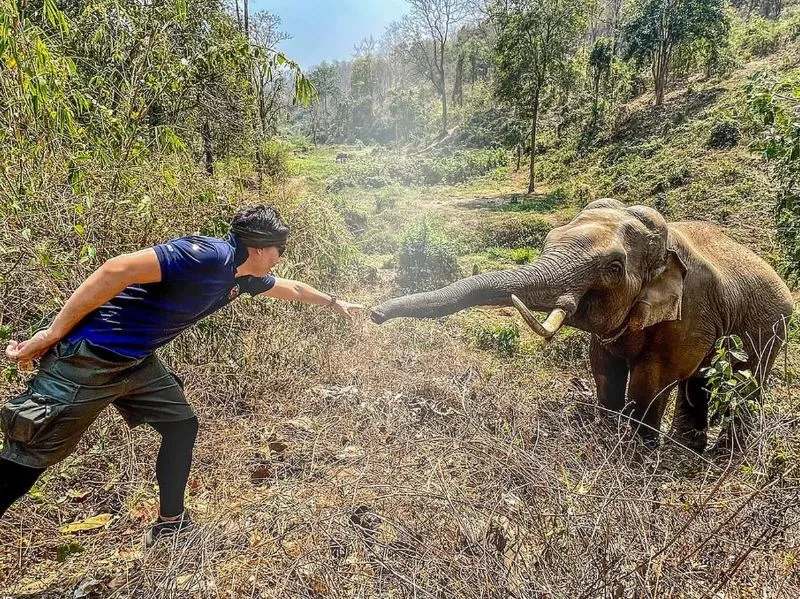
Then, slowly, the elephant extended his trunk.
For a long moment, time seemed to pause. The trunk — strong, wrinkled, and impossibly gentle — reached forward until it brushed against the man’s outstretched hand.
It was a greeting. A memory. A recognition.
And in that single gesture, twelve years of distance dissolved.
The Elephant on the Brink of Death
Back in 2009, the story had begun very differently.
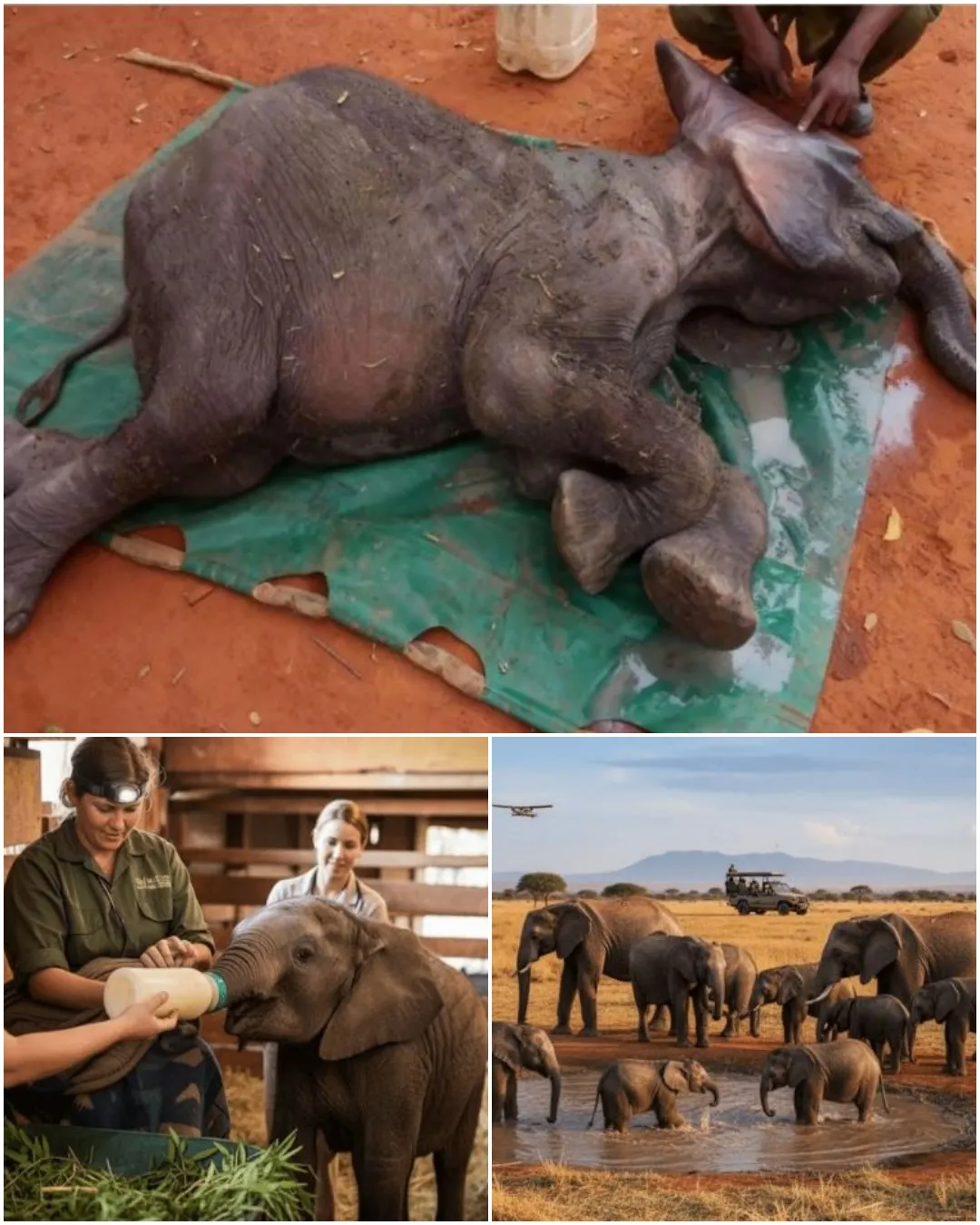
Plai Thang was not the powerful, healthy bull he is today. When rescuers found him in Rayong, eastern Thailand, he was barely clinging to life. The wild elephant was suffering from trypanosomiasis — known as “sleeping sickness” — a deadly parasitic infection that affects both humans and animals.
The disease had left him feverish, swollen, and weak. His limbs were stiff, his eyes inflamed, and his appetite gone. He could barely stand. Each breath came shallow and slow, the sound of a creature fighting not just illness, but exhaustion.
Most elephants in such condition don’t survive.
But fate intervened in the form of Dr. Pattarapol and his team.
When they found Plai Thang, the veterinarian knew that treatment would be long and uncertain. Yet he refused to give up. Together with the Forest Industry Organisation and the Department of National Parks, they transported the dying elephant to a protected area in Lampang province.
There, under a canopy of trees, began months of quiet struggle.
Every day, Dr. Pattarapol would visit the elephant, checking his vitals, cleaning his wounds, administering medicine, and ensuring that he was eating — if only a little.
Plai Thang was wary at first, his wild instincts sharp with fear. But over time, he began to recognize the man’s voice, the scent of medicine mixed with fruit, the soft words that always came before the sting of a needle.
And one morning, the doctor found him standing stronger, his eyes clearer. He reached for food with his trunk — a sign that life had returned.
After months of care, the elephant was finally strong enough to return to the wild. The release was bittersweet. The team opened the gates and watched as Plai Thang walked into the forest, free once again.
Dr. Pattarapol could only hope the wild would be kind to him.
A Reunion Beyond Words
Twelve years later, when that familiar sound echoed through the forest, neither man nor elephant could have expected what would follow.
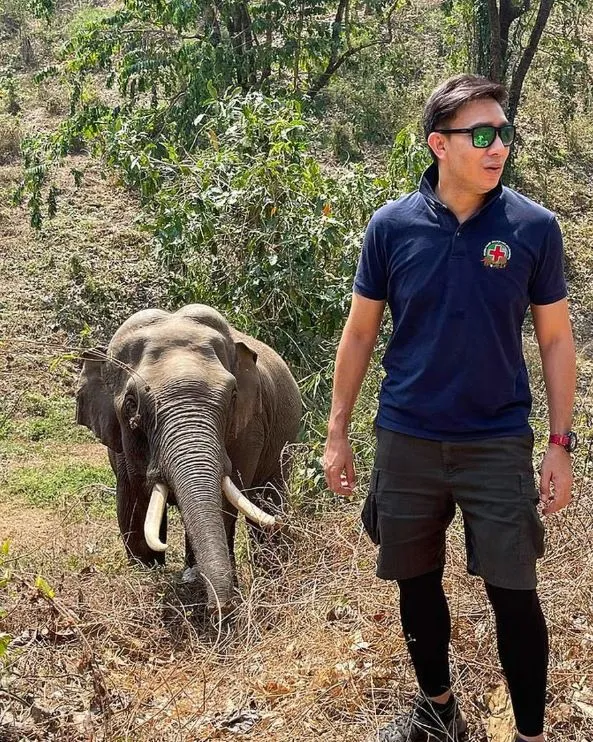
When Plai Thang appeared, his enormous frame was unmistakable — larger, stronger, but still bearing the unique patterns and scars that marked him as the same elephant Dr. Pattarapol once saved.
The veterinarian’s heart raced as he stepped forward, uncertain whether the elephant would remember him or even approach. But as he called out, something extraordinary happened: Plai Thang moved closer.
He lifted his trunk and reached toward the man — a gesture elephants reserve for trust, recognition, and affection.
When his trunk touched Dr. Pattarapol’s hand, the vet could feel the familiar warmth of the animal’s breath. “We could remember each other,” he later said. “We greeted. It was an extraordinary moment.”
For a wild elephant to approach a human after more than a decade — especially one with no recent contact — defied all expectations. But it also confirmed something wildlife researchers have long suspected: elephants never forget kindness.
The Memory and Heart of Elephants
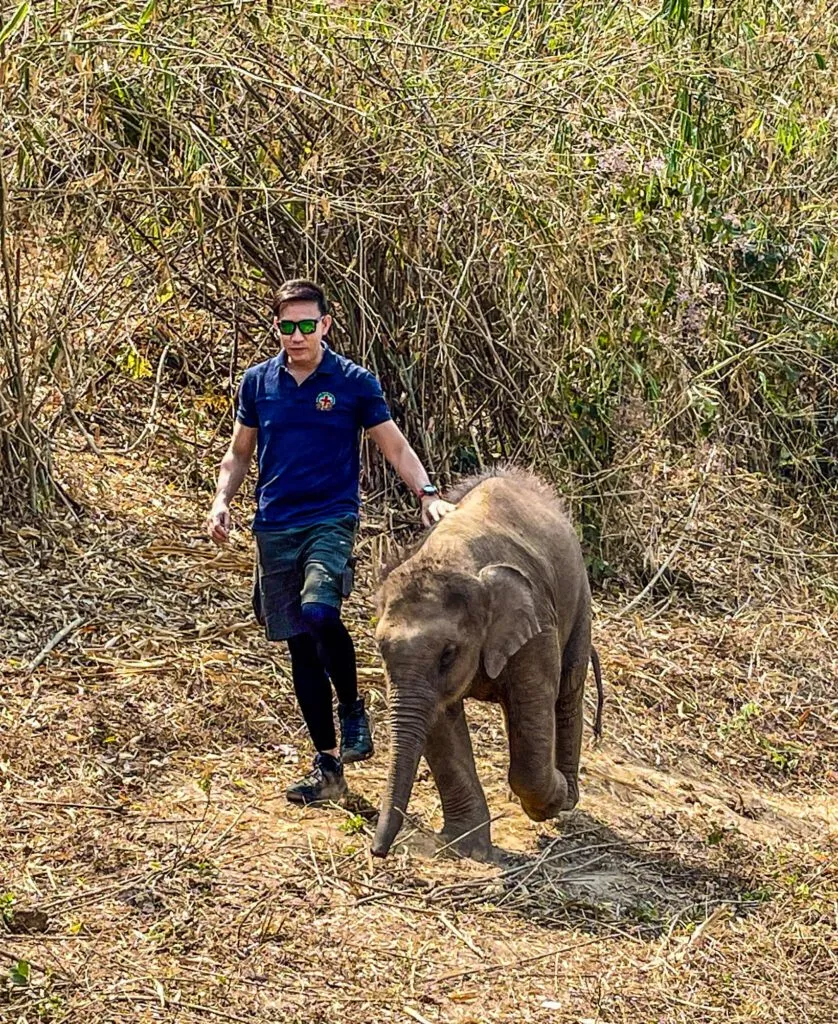
Elephants are renowned for their intelligence and emotional depth. Their brains, among the largest of any land animal, are wired for memory, empathy, and social connection.
They grieve their dead, comfort the distressed, and can remember individuals — both elephant and human — for decades.
Plai Thang’s recognition of Dr. Pattarapol is a testament to this extraordinary emotional memory. For twelve years, he had roamed free through dense forests, yet something in him remembered the human voice that once brought him back from the edge of death.
To the elephant, memory isn’t just about survival. It’s about connection — the same connection that binds herds together, that allows them to remember ancient water routes, that compels them to return to the bones of their dead.
It’s what makes them so achingly human in their emotions, yet utterly unique in their wisdom.
A Symbol of Hope and Harmony
When the video of their reunion was shared, it quickly went viral. Millions watched as the giant elephant extended his trunk toward the man who had once saved him. But behind the emotion lies a deeper message about the fragile bond between humans and wildlife.
In Thailand, elephants hold a special place — they are the country’s official animal and a national symbol of strength, wisdom, and peace. Yet they face mounting challenges.
An estimated 3,000 to 4,000 elephants remain in Thailand today, with roughly half living in captivity. Many are used in logging, entertainment, or tourism — industries that too often inflict lasting harm. Wild elephants, meanwhile, struggle as their habitats shrink due to deforestation and human encroachment.
For veterinarians like Dr. Pattarapol, every rescue is both a victory and a reminder of how much remains to be done.
His reunion with Plai Thang is not just a story about memory — it’s a story about hope. It shows that compassion can bridge the divide between species, that a single act of care can echo across years, and that healing — for animals and for humanity — begins with empathy.
Epilogue: The Gentle Touch of Recognition
As the sun rose higher that day, Plai Thang lingered for a while longer. His trunk brushed gently over the doctor’s hand one last time before he turned back toward the forest.
Dr. Pattarapol stood still, watching him fade into the trees. There were no words, no grand gestures — just the quiet understanding between two beings who had once met in suffering and were now meeting again in peace.
“It felt,” the veterinarian said later, “like seeing an old friend.”
And perhaps, in that moment, that’s exactly what they were — two souls connected by memory, compassion, and the enduring truth that kindness, once given, is never forgotten.