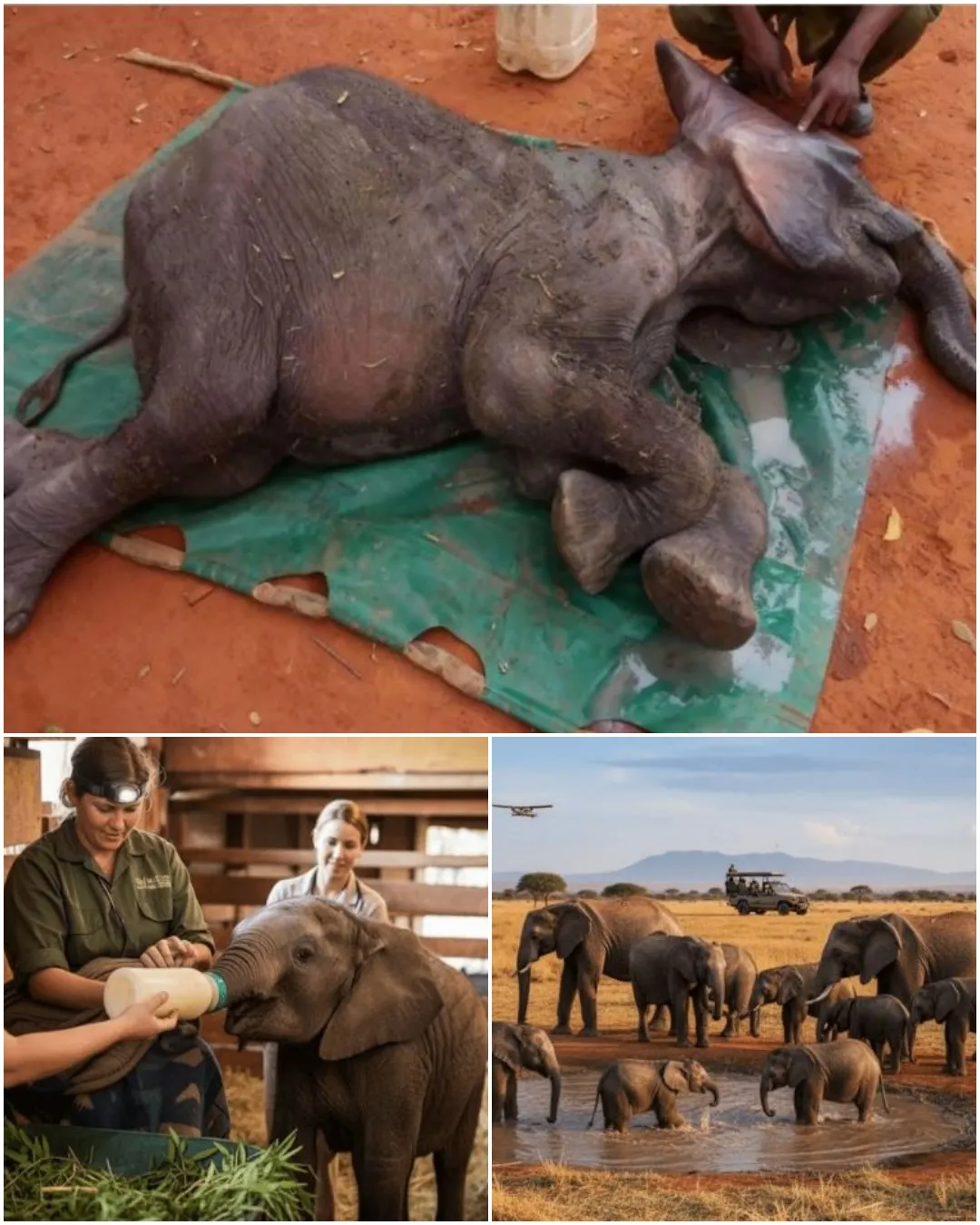
It began as an ordinary morning on the highway that cuts through the lush landscape of Tamil Nadu. The traffic was steady, horns blaring, engines rumbling — until the line of vehicles abruptly stopped. Up ahead, a group of majestic elephants had appeared out of the mist, slowly making their way across the busy road.
At first, there was surprise, then awe. Drivers stepped out of their cars, pulling out their phones to capture the sight. A herd of elephants, led by a matriarch, was crossing the road with deliberate calm. But then the crowd noticed something — a tiny calf lagging behind, struggling to climb over the edge of the tarmac.
The baby elephant, its legs slippery from the mud, stumbled again and again. Each time it tried to hoist itself up, gravity pulled it back down. The little one trumpeted in distress, unsure what to do next.
And that’s when the mother moved.
With a gentle but firm nudge of her trunk, she guided her baby forward, pushing it up the slope and onto the safety of the forest verge. The calf regained its footing, let out a small cry — half relief, half triumph — and followed its mother into the trees.
The crowd broke into applause. What they had witnessed was both heartwarming and humbling — a mother’s instinct to protect, to teach, to care. For a brief moment, a line of cars filled with impatient travelers became silent observers of something timeless: love and survival in the wild.
But as the elephants disappeared into the forest and traffic resumed, the moment left behind more than just admiration. It raised a question that India can no longer afford to ignore — what happens when the wild no longer has room to roam?

A Road Divided
The highway that the elephants crossed was once part of their ancient migration route, connecting forests, rivers, and grasslands across southern India. For centuries, elephants followed these invisible paths, passing safely through their territories to find water, food, and mates.
But the world around them has changed. Expanding cities, farmland, and highways now slice through these migration corridors, leaving elephants trapped between fragments of what were once vast forests.
In Tamil Nadu alone, areas like Coimbatore, Hosur, and Gudalur are home to nearly 700 elephants. As human settlements have expanded, so too have encounters between people and these giants of the jungle.
And these encounters are not always peaceful. According to local wildlife activists, about 20 people are killed every year by elephants in this region — and 10 to 15 elephants die annually, either in road accidents or at the hands of poachers and frightened farmers.
Across India, the numbers are even more alarming. In just one year, official data recorded 391 human deaths and 39 elephant deaths due to human-wildlife conflict. Behind each statistic lies a story of fear, loss, and misunderstanding — of two species forced into conflict by the shrinking boundaries of the natural world.

The Heart of the Problem
Wildlife activist Umesh Marudhachalam, who has spent decades studying elephant behavior in southern India, believes the issue is clear — and it starts with humans.
“The problem is not with the animals,” he explains. “It’s with us. We’ve destroyed their habitat and blocked their migration paths. They’re only crossing roads or entering farms because we’ve left them with no choice.”
Elephants, he says, are creatures of memory and habit. Once they have followed a path, they remember it for generations. When that path suddenly ends at a highway or housing development, confusion and tragedy often follow.
In some cases, herds have been seen wandering through villages at night, looking for food or water. Farmers wake up to trampled crops, frightened livestock, and broken fences. Elephants, in turn, face the wrath of humans who see them not as symbols of nature’s grandeur, but as threats to their survival.
“We call them intruders,” Umesh continues, “but really, it is we who have intruded into their homes.”

The Cost of Coexistence
The scene on the highway that morning was adorable, yes — but also symbolic. The mother’s push wasn’t just a moment of affection; it was an act of survival in a world that’s becoming increasingly hostile to her kind.
Each time an elephant crosses a road, it risks its life. Collisions between vehicles and wildlife are common in India’s forested regions, especially at night when visibility is low. In some cases, entire herds have been struck down by speeding lorries.
Despite this, elephants continue to cross. They have no alternative. The land that once belonged to them is now divided by asphalt and concrete.
Conservationists have long called for “wildlife corridors” — protected green pathways that reconnect fragmented forests and allow animals to move safely. Some efforts have been made in parts of southern India, but progress remains slow. Developers, landowners, and politicians often resist the idea, citing economic priorities.
Yet, as Umesh points out, “If we don’t act now, both people and elephants will keep dying. The price of inaction is already being paid — in blood, on both sides.”

A Moment to Remember
For the drivers who watched that elephant family cross the road, the incident might have seemed like a passing curiosity, a viral video waiting to happen. But for those who look closer, it was a message from the wild — a reminder that nature is still out there, adapting to a world it never asked for.
The mother’s gentle nudge symbolized more than just love. It represented resilience — a determination to keep moving forward, no matter how many obstacles lie ahead.

When the last of the herd vanished into the trees, the forest fell silent again. The cars revved, the horns blared, and life returned to its usual rush. But the elephants had left behind a quiet truth: coexistence is possible, but only if humans make room for it.
In the end, the calf’s journey across that stretch of asphalt may have been a small victory — but it carried a big lesson.
Because in every step those elephants take through our roads and farmlands, they are not trespassing. They are simply finding their way home.