The city never really sleeps.
Its lights flicker long after the sun has gone, its streets hum with the ceaseless motion of life — hurried footsteps, car horns, laughter, arguments, and the invisible rhythm of survival.
But in the shadows between the lights, where the noise fades and the world stops looking, quieter stories unfold.
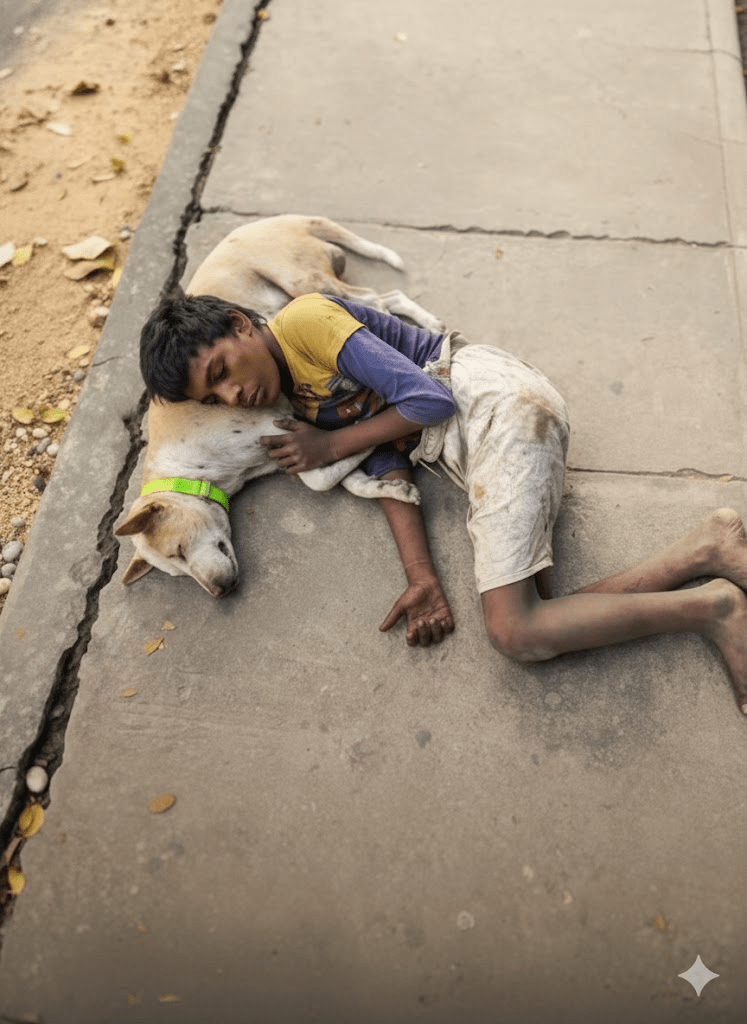
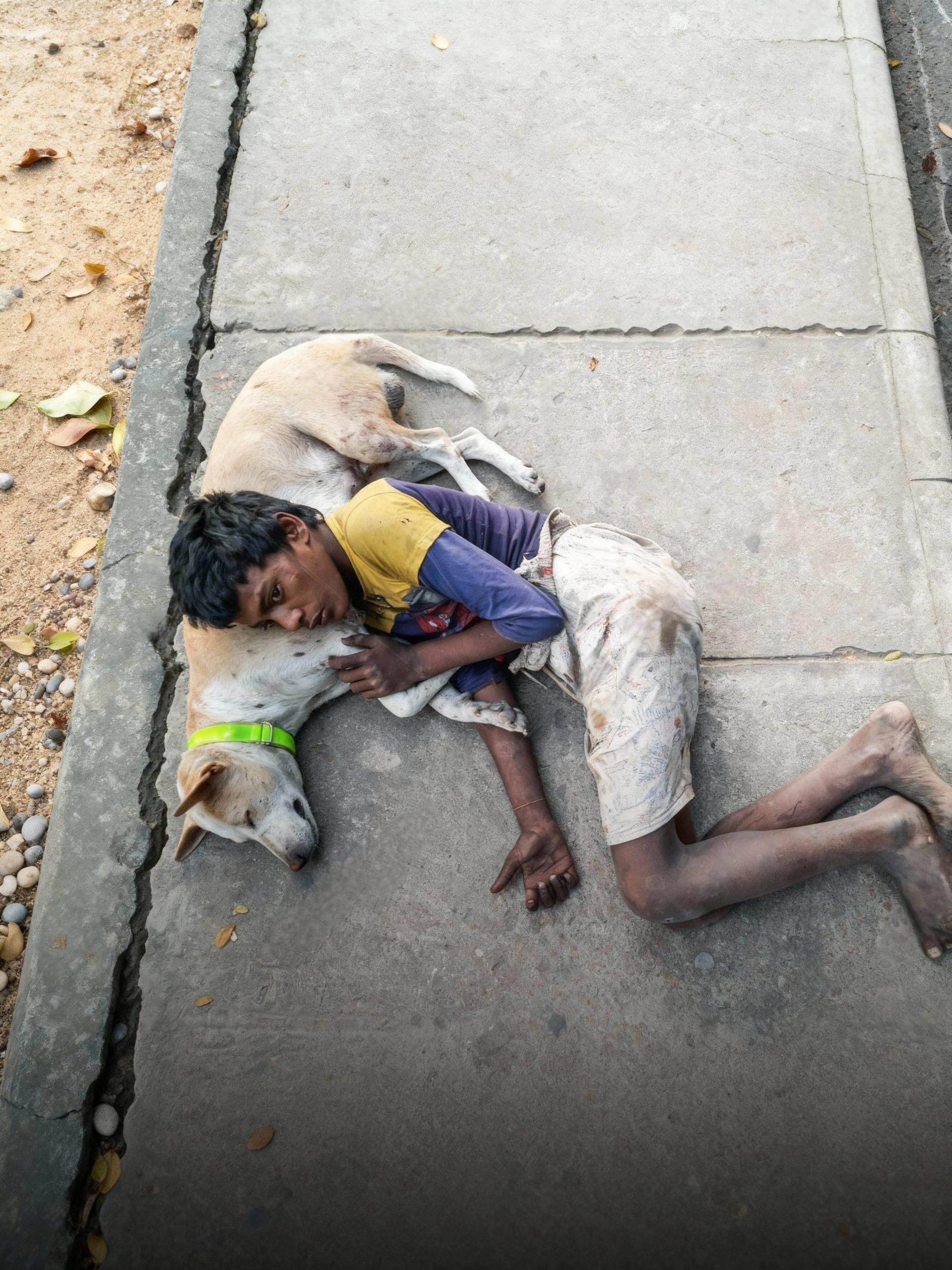
On one such corner, beneath the overhang of an old storefront, a boy sleeps.
His clothes are worn thin, his small frame curled against the chill of the concrete.
But he isn’t alone.
Curled beside him, pressed close enough that their breaths rise and fall together, lies a dog — thin, scarred, yet somehow regal in its stillness.
Its body forms a cocoon around the boy, shielding him from the wind, from loneliness, perhaps even from despair.
To the passersby, they might appear as another sad image of poverty — one more forgotten child, one more stray animal.
But to anyone who pauses long enough to look, truly look, something extraordinary reveals itself.
This is not a story of loss.
It’s a story of love — the kind that doesn’t need words or wealth, only presence.
No one knows exactly how they found each other.
Some say the boy, abandoned by circumstance, found the dog rummaging through trash behind a market.
Others say it was the dog who found him first, following his scent, drawn to the faint trace of kindness that still lingered on his skin despite the city’s cruelty.
However it began, what mattered was that from that day on, they were inseparable.
Each morning, as the city stirred awake, they became part of its living mosaic.
The boy would search for scraps — a half-eaten sandwich, a dropped apple, a forgotten coin.
The dog would watch over him, tail flicking, ears alert to danger.
At night, when the air turned cold and the concrete turned harder, the boy would pull the dog close, wrapping his thin arms around its neck, whispering quiet words into its fur — secrets, dreams, maybe even prayers.
And the dog, in return, would rest its head against his chest, its heartbeat syncing with his, as if to say, “I’m here. You’re not alone.”
People began to notice them.
The flower vendor who opened her stall before dawn would sometimes leave a small bowl of water nearby.
The man who ran the noodle shop would toss a piece of meat toward the dog now and then, pretending not to see when the boy divided it in half.
Even the police officer who patrolled the block seemed to look the other way.
In a city where kindness was rare, these small acts of mercy became lifelines.
But what truly sustained them was something deeper — a bond that transcended words.
For both, life had been stripped to its essence.
They had nothing — no home, no certainty, no possessions — except for each other.
In that fragile connection lay a kind of strength that comfort could never teach.
The boy called him Shadow.
It fit — the dog followed him everywhere, silent and steadfast, even when hunger gnawed or the rain fell in icy sheets.
Shadow seemed to sense danger before it came, growling softly when strangers drew too near, nudging the boy awake when the night grew too quiet.
And in return, the boy offered what little he had — half a crust of bread, a corner of a blanket, a gentle hand.
It wasn’t much.
But love, real love, never is about much.
One evening, as the sky bled into dusk, a woman passing by stopped in her tracks.
She was well-dressed, holding an umbrella, her shoes tapping against the pavement.
Something about the sight before her — the boy and his dog wrapped in each other’s warmth — made her pause.
The dog’s eyes met hers, calm and unflinching, and for a moment, she saw not a stray, but a guardian.
She snapped a photograph, quietly, almost reverently.
That photo would later travel the world.
People would share it online, calling it “the picture that broke and healed hearts at once.”
The image carried a message no caption could capture — that even in poverty, even in the cold, love survives.
That dignity can live on a sidewalk.
That loyalty doesn’t depend on wealth, only on will.
In the days that followed, donations began to pour in for homeless shelters and animal rescue groups.
The boy and Shadow became a symbol — not of pity, but of resilience.
Reporters searched for them, but they were never found.
Some say the woman returned to that same street weeks later, only to find the spot empty, a few scraps of blanket left behind.
Maybe they moved on to a quieter corner.
Maybe someone helped them.
Or maybe, as the romantic hearts like to believe, they finally found a home.
But perhaps that doesn’t matter.
Because the true beauty of their story wasn’t in its ending — it was in its existence.
For a brief, fragile moment in time, two souls met on the margins of a city and built a world of their own.
A world without judgment, without titles, without barriers.
Just a boy and his dog, holding on to each other while the city hurried past.
When the noise of life grows too loud, when we rush and forget, their image still lingers — a reminder carved into the collective conscience.
It tells us that love, in its purest form, often lives where we least expect it.
That sometimes, the most profound acts of grace happen not in cathedrals or grand homes, but on a cold pavement beneath a broken streetlight.
And maybe, somewhere out there, under another city sky, a boy whispers again to his faithful friend, “Don’t worry, Shadow. We’ll make it through.”
And the dog, with the heart of an angel and the eyes of forever, simply presses closer — saying everything without saying a word.