In the quiet rhythm of farm life, where dawn breaks to the hum of tractors and the soft whinnies of horses, tragedy and miracles often share the same sunrise.
When a mare passed away unexpectedly during childbirth, the farm fell into a hush that no rooster’s crow could lift.
Left behind was a fragile foal named Charlie—his trembling legs too weak, his cries for his mother echoing through the still morning air.
The farmers knew the odds.
They had raised animals for decades and understood the cruel arithmetic of orphaned foals: most don’t survive without their mother’s milk, warmth, and guidance.
They prepared bottles, mixed formula, and offered gentle hands, but no matter how much care they gave, something was missing—the heartbeat, the comfort, the instinctive love of a mother.
Then came Daisy.
Daisy was no stranger to responsibility.
A Border Collie born and bred for herding, she carried herself with a quiet intelligence, always alert, always aware of the rhythm of the animals around her.
When the mare’s stall fell silent, Daisy seemed to notice first.
She circled the pen, her eyes fixed on the small, trembling creature struggling to stand.
Something changed in her then—a softening, an awakening that no one could explain.
Her first approach was hesitant.
She stepped forward slowly, tail low, ears tilted, as if asking permission to enter this circle of grief.
Charlie, confused and frightened, backed away.
But Daisy persisted—inch by inch, moment by moment—her presence steady, her gaze calm.
When she finally reached him, she didn’t bark, didn’t nudge, didn’t assert herself as working dogs do.
She simply sat beside him.
From that moment, something beautiful began to unfold.
Over the next few days, Daisy refused to leave Charlie’s side.
She slept outside his stall, often pressing her body against the gate as if trying to transfer warmth through the wood.
When the farmers brought bottles of milk, she watched intently, almost as though ensuring they did it right.
And when Charlie finally stood on his wobbly legs, Daisy followed close behind, guiding him with a gentle patience that melted every heart who saw it.
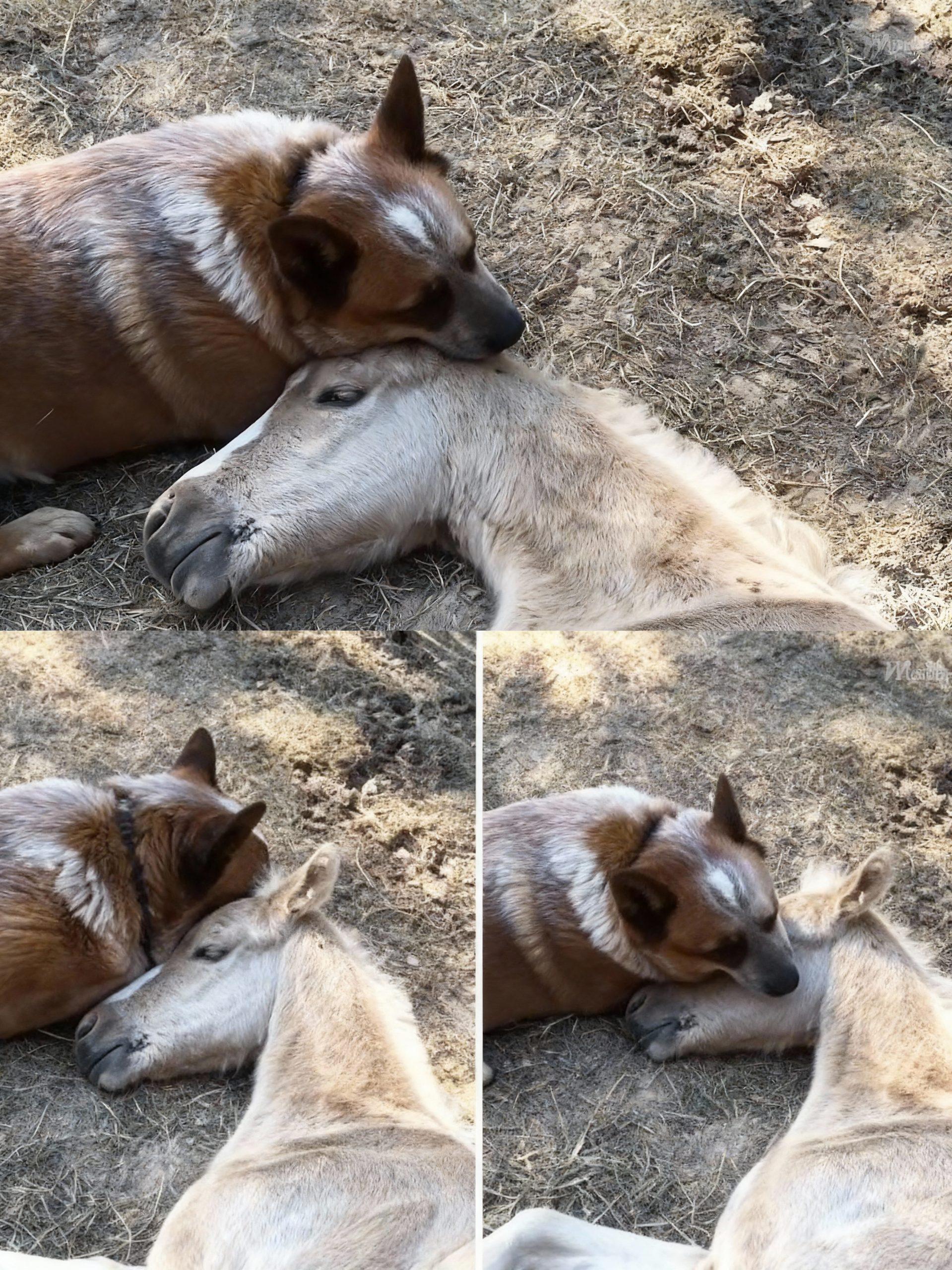
It wasn’t long before the two became inseparable.
Charlie would whinny softly whenever Daisy disappeared, and Daisy would come running, her paws thudding softly across the hay.
During the chill of the evening, she’d curl up beside him, her thick fur serving as the warmth his mother could no longer provide.
In those quiet moments, the boundaries of species blurred.
What remained was love—pure, instinctive, and profoundly maternal.
The farmers began to notice changes in Charlie too.
He grew stronger, steadier, more confident.
Where once he had been hesitant and frail, now he trotted around the pasture with a spark of playfulness.
Every leap he took seemed to mirror Daisy’s joyful energy.
When she barked at passing birds, he’d mimic her movements, as if learning from her how to be brave.
In a world that had taken his mother, Daisy had given him something just as powerful—the will to live.
One afternoon, as golden light streamed through the barn doors, the farmers watched in quiet awe as Daisy guided Charlie around the field.
She didn’t herd him; she accompanied him—always staying close enough for him to feel her presence, but far enough for him to learn to stand on his own.
It was as though she knew this little foal needed more than food and care; he needed courage.
And she would teach him that in her own way.
The local vet, who came by to check on Charlie, shook his head in amazement.
“I’ve seen orphaned animals adopt each other before,” he said softly, “but never like this. This… this is love in its truest form.”
Weeks turned into months, and the pair became the soul of the farm.
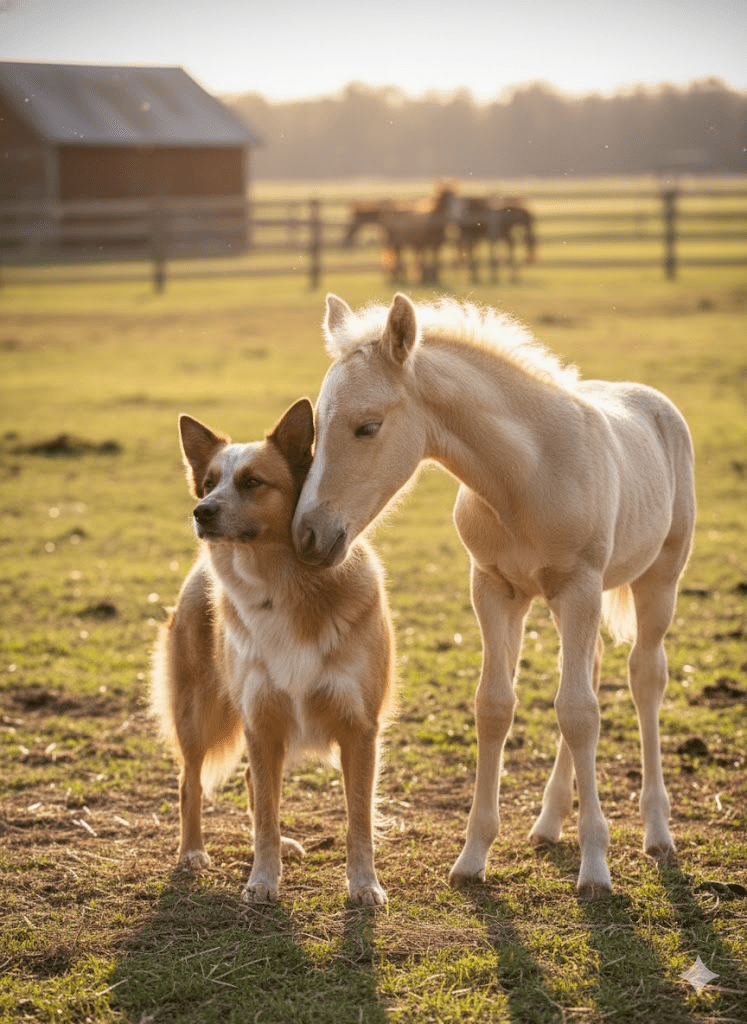
Visitors would often stop and stare in disbelief at the sight of a Border Collie resting beneath a young horse, their bond so natural it seemed ordained.
Children from nearby towns would come to see “the mother dog and her baby horse,” their laughter echoing across the fields.
Daisy would lift her head proudly, as if understanding the joy she had brought into the world.
Charlie continued to grow, and soon he towered over his unlikely guardian.
Yet, despite his size and strength, he never forgot the dog who had saved him.
He still followed Daisy wherever she went, lowering his great head to nuzzle her fur, sometimes resting his muzzle on her back as they walked.
When she grew tired, he would stand beside her like a sentry, protecting her as she once protected him.
Years later, when Daisy’s muzzle began to gray and her steps slowed, Charlie’s devotion only deepened.
On the day she passed, the farm fell silent again—only this time, the silence was filled not with grief, but with gratitude.
For in Daisy’s love, they had witnessed something sacred: a mother’s heart beating in a different form, unbound by species, driven only by compassion.
To this day, a small wooden plaque hangs in the barn above the stall where it all began.
It reads simply:
“Here, love crossed all boundaries.”
And every morning, as the farmers walk past, they remember how a Border Collie named Daisy taught them a lesson no book or lecture ever could—that motherhood is not defined by birth, but by the courage to love when it’s needed most.
Because in the end, Daisy didn’t just save a foal.
She reminded everyone on that little farm that the purest acts of kindness often come from those who expect nothing in return—only the quiet joy of seeing another life flourish.
Would you like me to add a bilingual Vietnamese translation (paragraph by paragraph) for this version, in the same emotional tone you used for Kennedy Maxie and Victoria Rose Smith’s stories?