The sky above Namibia’s Etosha National Park was once filled with life — the distant call of birds, the rustle of acacia leaves, and the heavy, deliberate footsteps of elephants making their way through the golden grasslands. But on this day, the air was different. It trembled with heat, choked with smoke, and carried the sound of crackling flames consuming everything in their path.
This was not nature’s rhythm. This was nature in agony.
The Inferno
The fire began quietly, as many do — a flicker among the dry brush. But in a season where rain hadn’t fallen in weeks and the land was already parched, that flicker became a monster. Driven by fierce winds, it leapt from one patch of grass to another, growing stronger by the hour.
Soon, Etosha’s vast plains — home to elephants, lions, zebras, rhinos, and hundreds of bird species — became an inferno.
Rangers, accustomed to protecting wildlife from poachers and drought, now faced an enemy that moved faster than any they’d ever seen. The flames spread so quickly that even the fastest animals struggled to outrun them.
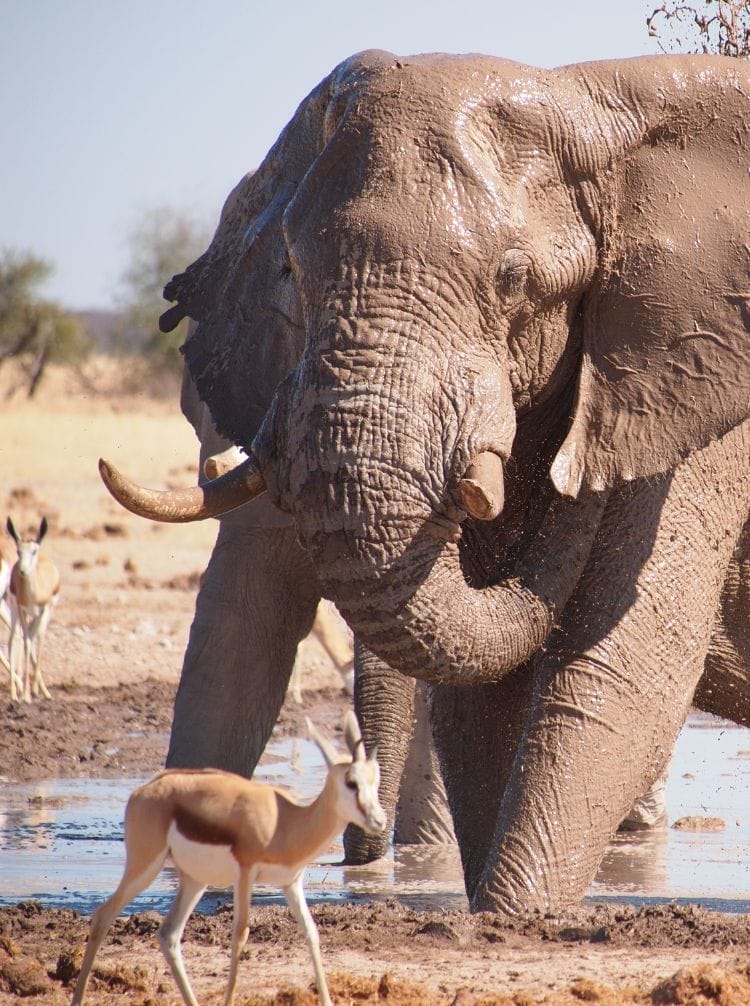
And among the victims was one of the park’s oldest residents — a great elephant bull, known by many of the rangers who had watched him for years.
The Fallen Giant
When the fire passed and the smoke began to clear, what remained was a haunting silence. The once-majestic elephant lay still, his massive body blackened by the flames.
He had likely tried to flee — his enormous tracks led toward a dried-up waterhole — but the fire had surrounded him. Caught between the walls of heat and smoke, there was nowhere left to run.
Rangers found him days later, his skin scorched, his tusks cracked from the intense heat. His body had become an unintentional monument — a symbol of what climate change is doing to Africa’s wild heart.
One ranger, speaking through tears, said softly, “We’ve lost more than an elephant. We’ve lost part of this land’s soul.”
The Widening Wound
The tragedy didn’t stop there. Across the park, countless animals were displaced or killed. Antelope fled for miles, their hooves burned. Birds fell from the sky, overcome by smoke. Families of zebras wandered through ash, confused and terrified.
The landscape — once vibrant with life — now looked like a battlefield: trees turned to skeletons, grass reduced to dust, and waterholes filled with soot.
Etosha, meaning “Great White Place” in the local language, was now cloaked in black.
For the rangers who dedicate their lives to protecting this park, the sight was unbearable. They worked tirelessly to reach injured animals, carrying buckets of water into the scorched zones and trying to save what life they could. But some areas were simply unreachable. The fire had burned too hot, too far, too fast.
The Human Hand Behind the Flames
Bushfires are not new to Africa — they’ve always been part of the natural cycle of life and renewal. But what’s happening now is different.
Prolonged droughts, record-breaking heat, and stronger winds are all symptoms of a planet in distress. Fires that once came once a decade now appear almost yearly. They’re hotter, faster, more destructive.
In regions like Etosha, where temperatures can reach over 100°F and rainfall is scarce, even a single spark — from lightning, or worse, from human negligence — can ignite a catastrophe.
Scientists and conservationists have warned for years that climate change would make events like this more frequent and more deadly. The Etosha fire is not just an isolated tragedy — it’s a warning, one written in ash and loss.
The Rangers’ Battle
For those on the frontlines, the rangers of Etosha, the days following the fire have been filled with heartbreak and exhaustion.
They search the charred landscape for signs of life — a movement in the grass, a faint sound, anything. When they find injured animals, they call in veterinarians and begin the long, painful process of treatment.
Some animals can be saved. Others cannot.
Even as the last embers fade, the work continues — rebuilding water sources, clearing fallen trees, and assessing the damage to the park’s fragile ecosystem. For them, the fire isn’t just an environmental disaster. It’s personal. They’ve named these elephants. They’ve watched them grow. They’ve protected them from poachers. And now, they must bury them.

The Cost of Ignoring the Warnings
The image of the burned elephant quickly spread across the world — a photograph both horrifying and necessary. It told the story words could not: that even the largest and strongest creatures on Earth are helpless in the face of our changing climate.
It’s easy to look away. To scroll past. But that elephant’s suffering is not distant. It’s a mirror.
Each degree of heat, each forest cleared, each unchecked fire adds to a chain of destruction that affects all of us — humans and animals alike.
Etosha’s fire was not just nature’s tragedy; it was humanity’s consequence.
A Call to Remember
Weeks later, small signs of life began to reappear. Tiny shoots of green grass emerged through the ash. A few birds returned. Nature, as it always does, began to heal — but it would take years to restore what was lost.
And for the rangers, for those who saw the elephant’s final moments, the memory will never fade.
They’ve since placed a small stone marker near where he fell. No grand monument, just a quiet reminder. On it, they wrote a few simple words:
“Here stood a giant. May we never forget.”
That elephant may be gone, but his story is not. It burns as fiercely as the fire that took him — a call to protect what little remains before it, too, turns to smoke.
Because if we don’t, Etosha’s tragedy will not be the last.