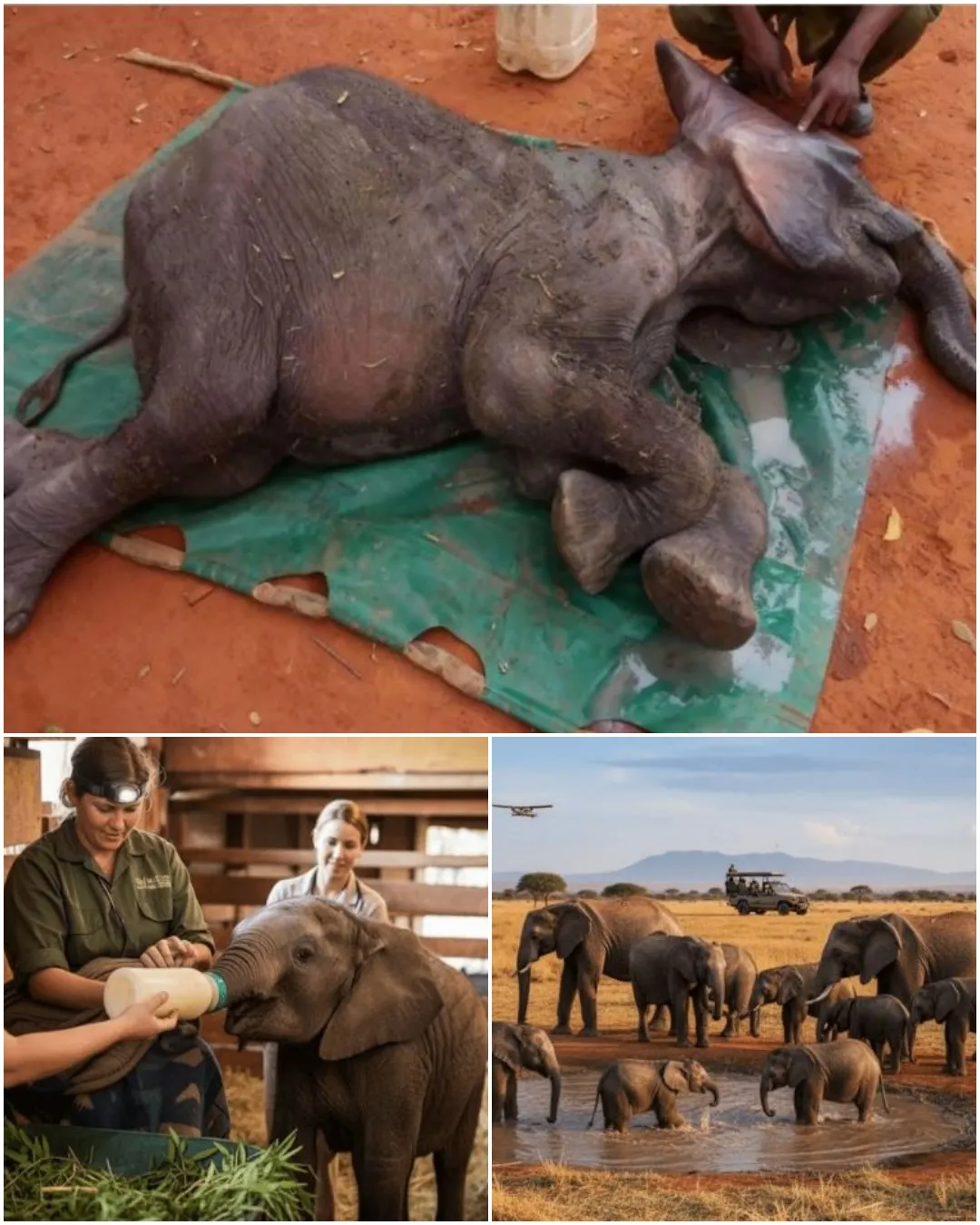
In the gentle morning light of a small elephant sanctuary in India, a playful baby elephant stumbled upon one of life’s first great mysteries: why didn’t her favorite human have a trunk?
The little calf, barely a year old, had spent her days exploring the world with boundless curiosity. Everything she knew came through her trunk — the soft brush of grass, the splash of water, the reassuring touch of her mother. The trunk was her tool, her voice, her comfort. So when she met her caretaker, a young woman who fed her, bathed her, and sang to her, something didn’t quite make sense.
One morning, as the caretaker crouched beside her, the calf reached out with her trunk to greet her as she would another elephant. But instead of another trunk reaching back, there was only a hand — small, soft, and far too short.
The baby paused. Her ears flapped in confusion. She reached again, tracing the girl’s face, her hair, her shoulders, searching for the missing trunk that should have been there. The caretaker laughed, her voice bright and gentle, while the calf let out a curious rumble — half confusion, half delight.
Then came the moment that melted hearts around the world. The elephant, still determined, reached for the girl’s face once more and tugged lightly at her nose, as if to say, “Where is it? How do you eat, smell, or hug without one?”
The young woman giggled, pretending to trumpet in reply, and the calf’s confusion turned into pure joy. She began to nuzzle her caretaker, wrapping her small trunk around the woman’s arm, as if accepting that maybe — just maybe — humans were simply strange, trunkless elephants.
The Language of Trunks and Touch
For elephants, the trunk is more than a physical feature — it’s their way of connecting with the world. A newborn calf’s first gesture is to reach for its mother’s trunk, seeking reassurance and warmth. Adult elephants greet each other by intertwining trunks, a gesture as intimate as a hug or a handshake. They comfort, play, and even mourn through this same language of touch.
In sanctuaries and the wild alike, trunks are also tools of incredible sensitivity. Scientists estimate that an elephant’s trunk has more than 40,000 muscles, capable of lifting a tree branch — or gently plucking a single blade of grass. For a baby elephant, the trunk is both a toy and a teacher.
So it’s little wonder that this calf, encountering a human who smelled kind and sounded gentle but looked so different, wanted to understand her world the only way she knew how — by touch.
A Symbol of Trust
Moments like this do not happen by chance. They are the product of patience, care, and deep respect between humans and elephants. In many sanctuaries across India and Thailand, rescued elephants learn that not all humans bring pain. These sanctuaries provide safe spaces where elephants once exploited for tourism, logging, or performance can finally live freely — and rediscover trust.
The calf’s caretaker had spent months earning that trust. She brought food each morning, offered baths in the afternoon, and spoke softly to calm the young elephant when she was frightened. The baby, in turn, began to see her not as a threat, but as family — a being to explore, play with, and love.
When the calf reached out to touch her caretaker’s face, it wasn’t just curiosity — it was connection. It was the moment when a rescued animal, born into uncertainty, decided that this human was safe.

The Joy of Curiosity
Elephants are known for their intelligence and curiosity. They recognize themselves in mirrors, use tools, and display complex emotions like grief and empathy. Young elephants, especially, are endlessly inquisitive — testing their trunks, their strength, and their surroundings at every opportunity.
This playful calf’s attempt to “find” her caretaker’s trunk is one of many examples of how elephants interact with the world in delightfully human ways. It’s the same curiosity that drives a kitten to chase its tail, or a puppy to tilt its head at a strange sound.
But in elephants, it’s paired with remarkable emotional awareness. They know when someone is kind. They remember faces, voices, even scents for years. Studies have shown that elephants can distinguish between friendly and threatening humans just by listening to their tone of voice.
So when this calf tugged at her caretaker’s nose, it wasn’t just a cute moment — it was a sign of trust, affection, and innocent discovery.


A World of Unlikely Friendships
The footage of this encounter quickly spread online, bringing smiles to millions around the world. And it wasn’t alone — similar moments of interspecies curiosity continue to remind us of the beauty of empathy in the animal kingdom.
A kitten cautiously befriending a hedgehog, a dog meeting a tiny pig for the first time, a horse nuzzling a baby goat — these moments show that wonder knows no boundaries. Across species, across instincts, connection finds its way.
For the baby elephant, her caretaker may have been a mystery at first. But as the days passed, she no longer cared about the missing trunk. What mattered was the laughter, the food, and the gentle hands that replaced fear with love.


A Small Moment, A Big Message
In a world where elephants are still poached, chained, and exploited for entertainment, this small, joyful moment carries a profound message. Compassion — simple, human compassion — can heal even the deepest divides.
The video of the baby elephant tugging at her caretaker’s face may last only seconds, but it captures the very essence of coexistence: curiosity met with kindness. A calf reaching out not in fear, but in wonder. A human responding not with control, but with love.
Perhaps that’s why it resonates so deeply. Because in that simple act of touch — trunk to hand, heart to heart — we see what the world could be if we treated all living beings with the same gentleness.
The baby elephant may never understand why her friend doesn’t have a trunk. But she doesn’t need to. She’s already learned the most important truth — that love doesn’t always look the same, but it always feels familiar.
📌 Watch the adorable moment in the full video below — and share it to remind others that curiosity, kindness, and connection are the universal languages of life.