In the wild, everything depends on timing — the rise of the sun, the chase of a predator, the heartbeat between life and death. For those who live by instinct, one second too early or too late can change everything.
That morning, the air was still and heavy with heat when Jonathan Jones, a guest at Tafika, set out on his game drive. The bush was quiet, yet full of promise — that rare stillness before something remarkable happens. None of them knew that within hours, they would witness a scene few people ever see in their lifetime: a leopard mid-hunt, suspended between success and failure.
The Hunter in the Ebony Tree
High above the dusty earth, Olimba, a powerful female leopard, rested on the thick branch of an ebony tree. She was the picture of beauty and control — sleek muscles, golden eyes, the faintest twitch of her tail betraying her awareness of everything below.
The morning had already been eventful. Olimba had taken down a young puku — a small, delicate antelope — earlier in the day. The kill was quick, but nature offers no peace in victory. The cries of the mother still echoed through the bush, a haunting sound of grief and instinct.
Leopards are masters of patience. As the sun climbed, Olimba carried her kill into the shade of the tree, where the breeze whispered through the leaves. Below, the mother puku paced in confusion and pain, searching for her lost young. Olimba watched silently.
For hours, the two mothers — one predator, one prey — existed in the same frame of life, bound by the same story of survival.

The Moment Builds
As the heat pressed down, the puku wandered closer, calling out in short, sharp whistles that carried across the plain. Her distress filled the air — a sound both heartbreaking and dangerous.
Olimba’s head lifted. Her muscles tightened.
Here was another chance.
Leopards don’t waste energy unless they sense an opportunity. And this one was close, distracted, and vulnerable. Olimba’s instincts took over. She began to move, slow and deliberate, her paws silent against the bark. Her tail flicked once — the signal of focus.
Jonathan and his guide had positioned their vehicle far back, ensuring they would not disturb the scene. From that distance, they watched, breathless, cameras poised.
A perfect storm of tension hung in the air — predator above, prey below, both unaware of just how fleeting the next moment would be.
The Leap
And then, it happened.
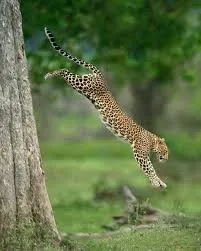
With a flash of movement, Olimba sprang from the high branch — a golden blur slicing through sunlight and shadow. The guests gasped. For an instant, time seemed to stop.
The leopard’s body was magnificent in motion, every muscle stretched in precision. She had calculated the distance perfectly — or so it seemed.
But the mother puku, driven by something more powerful than instinct — the raw, unstoppable will to live — reacted just in time. With a startled whistle, she darted forward. Olimba’s paws hit the ground hard, claws swiping at empty air.
Dust exploded around her.
The puku fled, her white tail flashing like a ghost as she disappeared into the tall grass.
Olimba stood still for a moment, chest heaving, her eyes fixed on the place where her prey had been. A soft growl escaped her throat — not anger, but acknowledgment. Even the best hunters sometimes miss.

Nature’s Balance
For the guests, the moment was electric. Jonathan’s camera clicked rapidly, freezing the leap in midair — a rare capture that most wildlife photographers only dream of. The power, the precision, the grace of the leopard — all of it balanced perfectly against the heartbreaking escape of the mother puku.
The guide exhaled slowly. “Timing,” he murmured, “is everything.”
Olimba climbed back into the tree, her movements calm again. She would wait out the day, conserve her strength, and try again when the time was right. That is the way of the wild — patience, persistence, and respect for every loss as much as every victory.
In that moment, the guests weren’t just watching a predator fail to hunt. They were witnessing something deeper — the balance that keeps nature whole.
Through the Lens
Later, when Jonathan looked through his photographs, he could hardly believe what he’d captured.
Frame by frame, the story unfolded — the mother’s stillness, the tension in Olimba’s body, the explosive leap, the cloud of dust, the instant of near contact. It was all there — a sequence that told not just a story of predator and prey, but of the fragile thread that ties them both together.
Wildlife photography often demands patience, but sometimes, it’s about luck — being in the right place, at the right time, with eyes open and heart ready. Jonathan had timed it perfectly. Olimba, this time, had not.
And yet, in a strange way, both had created something beautiful — one through survival, the other through art.

The Lesson in the Miss
For Olimba, the day’s miss wasn’t failure. It was part of the rhythm of her life. A leopard may hunt dozens of times before success. Every chase, every leap, every mistake sharpens her skill. She will feed again. She will raise her cubs.
For the puku mother, the escape meant one more sunrise, one more chance to live. For the photographer, it meant witnessing a story that will never repeat itself the same way again.
Timing is everything — and in the wilderness, it belongs to no one.
Sometimes, the hunter misses. Sometimes, the hunted escapes. But always, life goes on.

A Moment to Remember
When the group returned to camp that evening, the golden light fading behind the horizon, conversation buzzed with excitement. Everyone knew they had witnessed something special — not a clean kill or dramatic chase, but a rare, fleeting moment where nature showed its raw, honest truth.
As the fire crackled and the night sounds rose around them, the guide smiled and raised his glass. “To Olimba,” he said. “To perfect imperfection.”
And to timing — that invisible force that rules the wild, and all of us who watch it with wonder.