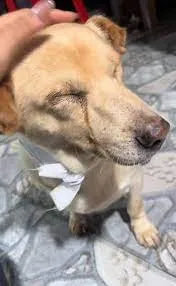
The funeral took place on a cloudy afternoon in a quiet town in the West. The air was thick with incense, grief, and silence. Relatives and neighbors stood around the wooden coffin, their faces pale and eyes swollen from crying. But amid all the mourning figures, there was one small shadow that caught everyone’s attention — a tiny dog wearing a white scarf.
Its fur, once shiny and soft, now looked dull and messy as if it hadn’t been brushed for days. The scarf around its neck was loosely tied, a symbol of mourning in that family. It sat there quietly, huddled in front of the altar, its small body trembling slightly. Its eyes — red, swollen, and wet — were fixed on the portrait of an old man smiling gently from a framed photo.
That man was its owner — the one everyone called “Grandfather.”

Grandfather had raised the dog from the day it was found abandoned on a rainy night. He named it “Lucky,” saying that perhaps it was fate that brought them together. Every morning, Lucky followed him to the garden, watched him water the plants, and waited for him to finish breakfast so they could go for a walk. They were inseparable companions for nearly ten years.
But one morning, Grandfather didn’t wake up. Lucky pawed at his bed, whimpering softly, not understanding why the old man no longer responded. From that day on, the little dog stopped eating properly, spending hours lying at the foot of the bed, as if waiting for him to return.
Now, at the funeral, Lucky seemed to understand that this was goodbye. It didn’t bark, didn’t wag its tail, didn’t move much. It just sat there, quietly staring at the altar, as though trying to memorize that familiar face for the last time.
The guests whispered among themselves.
“Poor thing… It must miss him so much.”
“Animals have hearts too. Look at those eyes — they’re crying.”
Tears rolled down the cheeks of people who had tried so hard to stay strong. There was something painfully beautiful in that silence — the kind of grief that needed no words.

As the ceremony ended, family members lined up to say their final farewells. The coffin lid was about to be closed. That was when something unexpected happened.
Lucky suddenly stood up. For the first time in two days, it barked — a soft, broken sound, like a sob. Then it rushed forward, jumping onto the wooden coffin, scratching it gently with its tiny paws as if trying to wake its owner one last time.
The family froze. The priest stopped chanting. Every eye turned toward the little dog. Someone tried to pull it away, but Lucky clung tighter, its cries echoing through the hall. It wasn’t just a sound — it was heartbreak made audible.
Finally, the eldest son knelt down, his tears falling onto the dog’s fur. “Let it stay a little longer,” he whispered. “Father would want that.”
So they let Lucky lie there, its head resting gently on the coffin lid. For a few silent moments, time seemed to stop. The only sound was the faint whimper of a heart that refused to let go.
When the coffin was finally carried away, Lucky followed. It walked behind the pallbearers all the way to the graveyard, step by step, as if it understood the path to the final resting place. Even when the last shovel of soil was laid, it refused to leave. It just sat there, watching, as though waiting for the man who would never return.
In the days that followed, the family noticed something strange. Lucky wouldn’t eat. It kept lying by the grave, no matter the weather — rain, wind, or sun. The children brought food and blankets, but the dog barely moved. It seemed to be guarding something sacred, something no one else could see.
One morning, they found Lucky lying still by the grave, its body cold, its face peaceful. It had passed away quietly, as if choosing to follow its beloved master to another world.
The news spread quickly through the village. People came to lay flowers at the spot where Lucky rested. “He was loyal till the end,” someone murmured. “Even humans sometimes can’t love like that.”
Years later, the story of the little dog and its master became a local legend. The graveyard caretaker planted a small tree beside their graves, saying it was for both of them — the man and his loyal friend.
And every year, when the wind rustled through the leaves, villagers swore they could still hear the soft bark of a dog, echoing somewhere in the distance — a sound of love that never truly died.