AITA for dropping him and his daughter off at a rental car place states away from home?
A mother’s heart swells with hope and excitement as she plans a once-in-a-lifetime road trip for her young sons, determined to create memories they’ll cherish forever. For the first time, she’s able to give them the adventure they’ve always dreamed of, pouring love and effort into every detail, ready to watch their faces light up with joy and wonder.
But the fragile bubble of happiness bursts when an unexpected companion joins the journey—a teenage girl who has never hidden her disdain for the woman trying to love her family. What was meant to be a bonding experience quickly turns into a relentless battle of tension and frustration, threatening to unravel the delicate threads holding this blended family together.













Subscribe to Our Newsletter
As renowned researcher Dr. Brené Brown explains, “Boundaries are the distance at which I can love you and me simultaneously.” This situation is a severe breakdown of relational boundaries, initially established by the OP through the unilateral planning and financial commitment to her children's surprise trip. When Dave unilaterally inserted himself and his daughter into this pre-planned, emotionally charged event, he effectively erased the OP's established boundary regarding the trip's purpose and participants.
Ann’s behavior—openly stating the OP is "boring" and later exhibiting extreme entitlement during the trip—demonstrates a lack of respect for the OP as a host and an elder. Dave's actions exacerbated the conflict; he prioritized his daughter's comfort (and likely avoiding conflict with her) over the OP's stated desires (not wanting them to come) and later over the OP's right to drive her own vehicle. Dave's insistence on sticking together forced the OP to tolerate behavior detrimental to her children’s experience, leading to severe emotional exhaustion for the OP.
The OP’s action of ejecting Dave and Ann was an extreme, reactive measure born from feeling completely overpowered and disrespected over several days. While communication leading up to the incident failed, enforcing a boundary suddenly and dramatically, 800 miles from home, is highly punitive. A more constructive approach would have been to explicitly state beforehand that Ann’s behavior would result in an immediate, safe departure from the trip (e.g., dropping them at the next major transit hub) rather than waiting until the OP's own emotional breaking point, which resulted in significant financial and logistical distress for the ejected parties.
THIS STORY SHOOK THE INTERNET – AND REDDITORS DIDN’T HOLD BACK.:
Users didn’t stay quiet — they showed up in full force, mixing support with sharp criticism. From calling out bad behavior to offering real talk, the comments lit up fast.
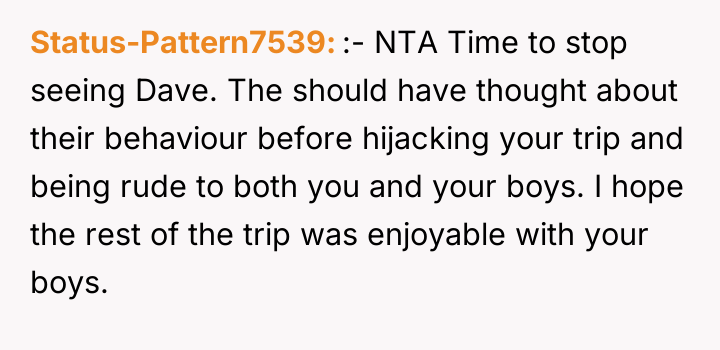

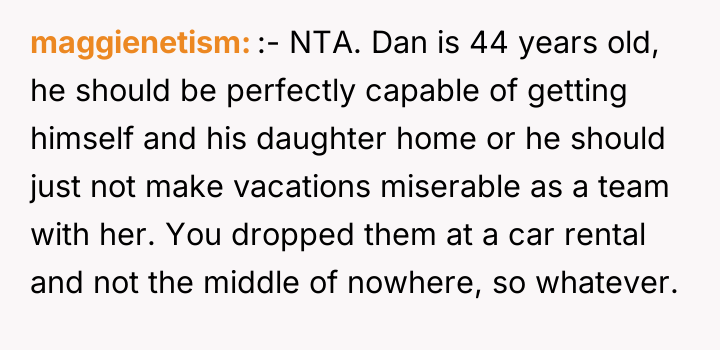


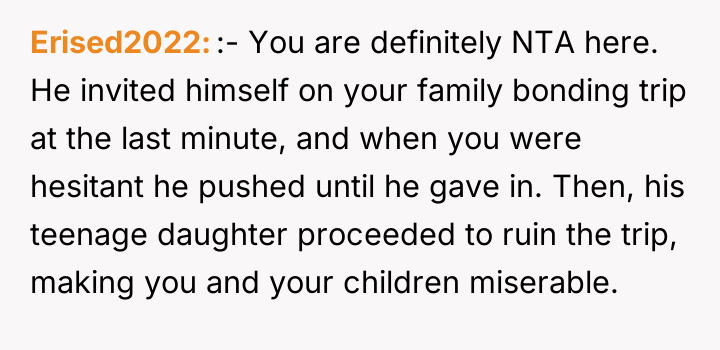
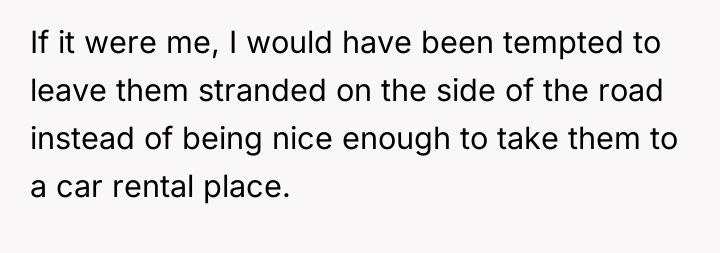
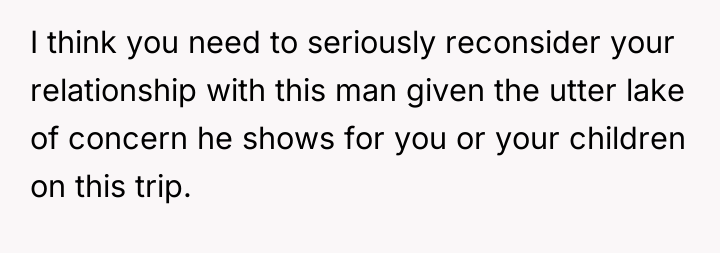

The original poster (OP) organized a highly anticipated, expensive, and emotionally significant trip for her children, which was suddenly co-opted by her partner, Dave, and his openly hostile daughter, Ann. The central conflict arose when the OP's boundaries were repeatedly ignored, culminating in her decision to unilaterally end the trip for Dave and Ann due to their constant complaints and poor behavior, forcing them to find an expensive and difficult way home.
Given that the trip was planned entirely for the OP's children and her financial investment, was the OP justified in immediately removing Dave and Ann from her vehicle to protect her sons' experience, or did forcing them 800 miles from home constitute an excessive and cruel response to poor travel etiquette?