Tips & Hacks6 min read
How to Get Rid of Fruit Flies Fast, and Keep Them From Coming Back
A cloud of tiny flies around the fruit bowl can appear almost overnight. A simple trap catches the adults, but the real fix is finding where they are breeding.
It starts with one or two. You wave them away from the bananas and forget about it. A few days later there is a small cloud above the fruit bowl, more circling the bin, and one doing slow laps around your glass of wine.
Fruit flies are not dangerous in the way some pests are, but they are annoying, they can carry bacteria from rotting food onto clean surfaces, and they multiply with alarming speed. The good news is that they are also easy to beat, as long as you deal with both the adults and the place where they are breeding.
The quick answer
- Remove the source: overripe fruit, food scraps, sticky spills, the bin and anything fermenting.
- Set a few vinegar traps: a little apple cider vinegar with a drop of washing-up liquid in a small bowl or jar.
- Clean drains, bin lids and the underside of the fruit bowl.
- Keep it up for about two weeks so that newly hatched flies are caught before they can breed.
Why they appear so suddenly
The common fruit fly, Drosophila melanogaster, is one of the most studied animals on Earth, precisely because it breeds so quickly. Females lay their eggs on the surface of fermenting fruit and other moist, decaying organic matter. Over her life, a single female can lay several hundred eggs.
At a warm room temperature of around 25 degrees Celsius, a fruit fly can go from egg to adult in a little over a week, and adult females can start laying eggs within a couple of days of emerging. That is why a handful of flies can become a swarm so fast, and why a problem that seems solved can flare up again a week later.
Where do the first ones come from? Often they arrive as eggs or larvae on fruit and vegetables bought from a shop or market, especially bananas, tomatoes, grapes and soft fruit. Adults also find their way in from outside through open windows and doors, drawn by the smell of fermentation.
Step 1: Find and remove the breeding site
Traps catch adult flies, but they do nothing about the eggs and larvae. If you skip this step, new flies will keep hatching. Check:
- The fruit bowl. Throw away or eat anything overripe, bruised or split. Check the bottom of the bowl for juice or a forgotten grape. Keep ripe fruit in the fridge for a while.
- Potatoes and onions. A single rotting potato or onion at the bottom of a bag is a classic culprit, and it is easy to miss.
- The bin and food-waste caddy. Empty them often, wash them out and make sure the lids close well.
- Recycling. Rinse bottles, cans and jars before they go into the box. Wine, beer and juice residues are ideal for fruit flies.
- Spills and sticky spots. Under the toaster, behind the kettle, inside the cupboard where the jam leaked.
- Cleaning cloths and mops. Damp, food-soaked sponges and mops can become breeding sites. Wash or replace them.
- House plants. Over-watered compost can attract small flies, although these are often fungus gnats rather than fruit flies.
Step 2: Make a trap that actually works
Fruit flies are attracted to the smell of fermentation: acids, alcohol and yeast. That is what the classic trap exploits.
The vinegar and soap trap
- Pour 2 to 3 centimetres of apple cider vinegar into a small bowl, glass or jar.
- Add one or two drops of washing-up liquid and stir gently.
- Put the trap where you see the most flies, such as next to the fruit bowl or bin.
- Replace the vinegar every few days, or as soon as it fills up with flies.
The washing-up liquid is the important part. It breaks the surface tension of the liquid, so flies that land to drink sink instead of standing on the surface and flying away again. Without the soap, many flies escape.
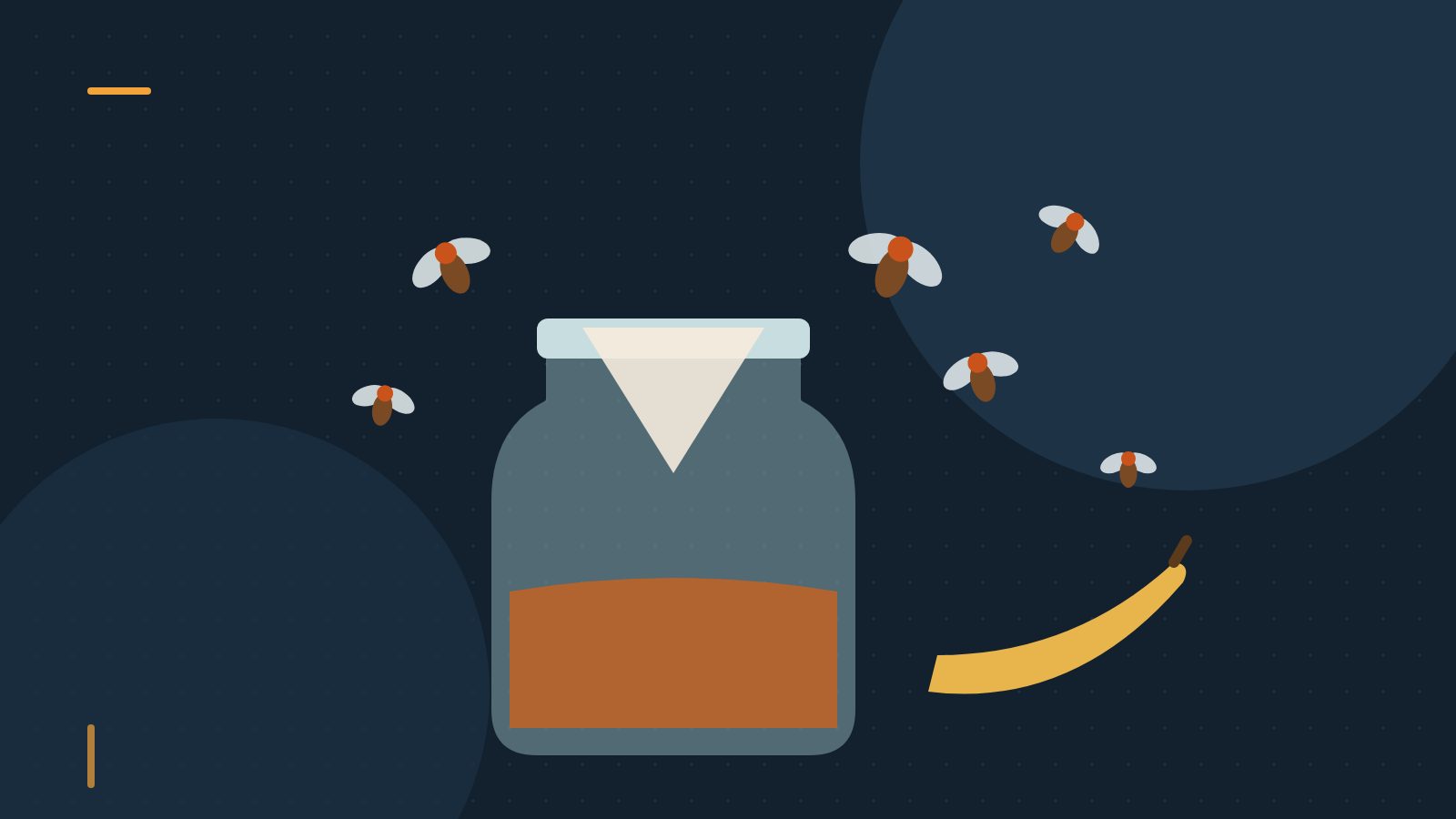
You can cover the jar with cling film held by a rubber band and poke a few small holes in it with a toothpick. Flies find their way in more easily than out. A paper cone in the neck of a jar, narrow end down, works the same way.
Other baits that work
- A splash of red wine or beer left at the bottom of a bottle or glass, with a drop of soap.
- A piece of very ripe banana in a jar covered with perforated cling film.
- A mix of vinegar and a little fruit juice if plain vinegar is not working.
Apple cider vinegar usually works better than white vinegar because it smells more like fermenting fruit.
Shop-bought traps
Ready-made fruit fly traps and sticky yellow cards are widely available and work on the same principle. They are tidy and convenient, but they are not more powerful than a well-made homemade trap, and they still do not remove the breeding site.
Step 3: Check the drains
If you have removed every piece of fruit and the flies keep appearing near the sink, the drain may be the problem. Food residues and the slimy film inside pipes can attract flies.
Clean the plug hole and the overflow with a brush and hot soapy water, remove any food or hair you can reach and run plenty of hot water afterwards. Enzyme-based drain cleaners help break down organic build-up over time.
To find out whether your flies are coming from the drain, tape a clear plastic bag or a piece of cling film loosely over the plug hole overnight. If you find flies trapped underneath in the morning, the drain is involved.
Fruit flies or drain flies?
Not every tiny fly is a fruit fly. It helps to know the difference, because the solutions are different.
- Fruit flies are about 3 millimetres long, tan or light brown, often with red eyes. They hover around fruit, bins and drinks.
- Drain flies, also called moth flies, are fuzzy, grey and moth-like, with wings held like a tent over the body. They sit on walls near sinks, showers and toilets and fly weakly. They breed in the slime inside drains, so cleaning the pipes is the main fix.
- Fungus gnats are small, dark and long-legged, and they usually hang around house plants. Letting the compost dry out between waterings is the best remedy.
What does not work very well
- Bug sprays alone. They kill the flies you hit, but the next generation is already on its way. Avoid spraying insecticides near food.
- Bleach down the drain. It may kill a few larvae on contact, but it runs straight past the organic film where they live and can be harmful. Physical cleaning is more effective.
- Waiting for them to leave. As long as there is food, they will not.
How long does it take?
If you remove the breeding sites and keep the traps going, you should see a big drop within a few days. Because eggs and larvae may already be developing somewhere, it can take one to two weeks to catch the last stragglers. Keep a trap out for a while after the last fly disappears.
How to keep fruit flies away
- Store ripe fruit in the fridge, especially in summer.
- Wash fruit and vegetables when you bring them home to remove eggs on the skin.
- Take out food waste every day or two and keep bin lids closed.
- Rinse recycling before you store it.
- Wipe up spills, including sticky residues on worktops and in cupboards.
- Do not leave dirty dishes, open drinks or pet food out overnight.
- Clean sink drains regularly.
- Fit fine fly screens on kitchen windows during warm months.
The bottom line
Fruit flies are a symptom. The vinegar trap deals with the adults you can see, but the swarm will keep coming back until you find the overripe banana, the forgotten potato or the sticky recycling where the next generation is growing. Remove the source, trap the adults and give it two weeks. Your fruit bowl, and your glass of wine, will be yours again.