Animals5 min read
Crows Remember Your Face, Tell Their Friends and Hold a Grudge for Years. Here's the Science
A researcher in a rubber mask, a campus full of angry birds and a girl who received gifts from her feathered neighbours. Crows are far cleverer, and far more personal, than most people realise.
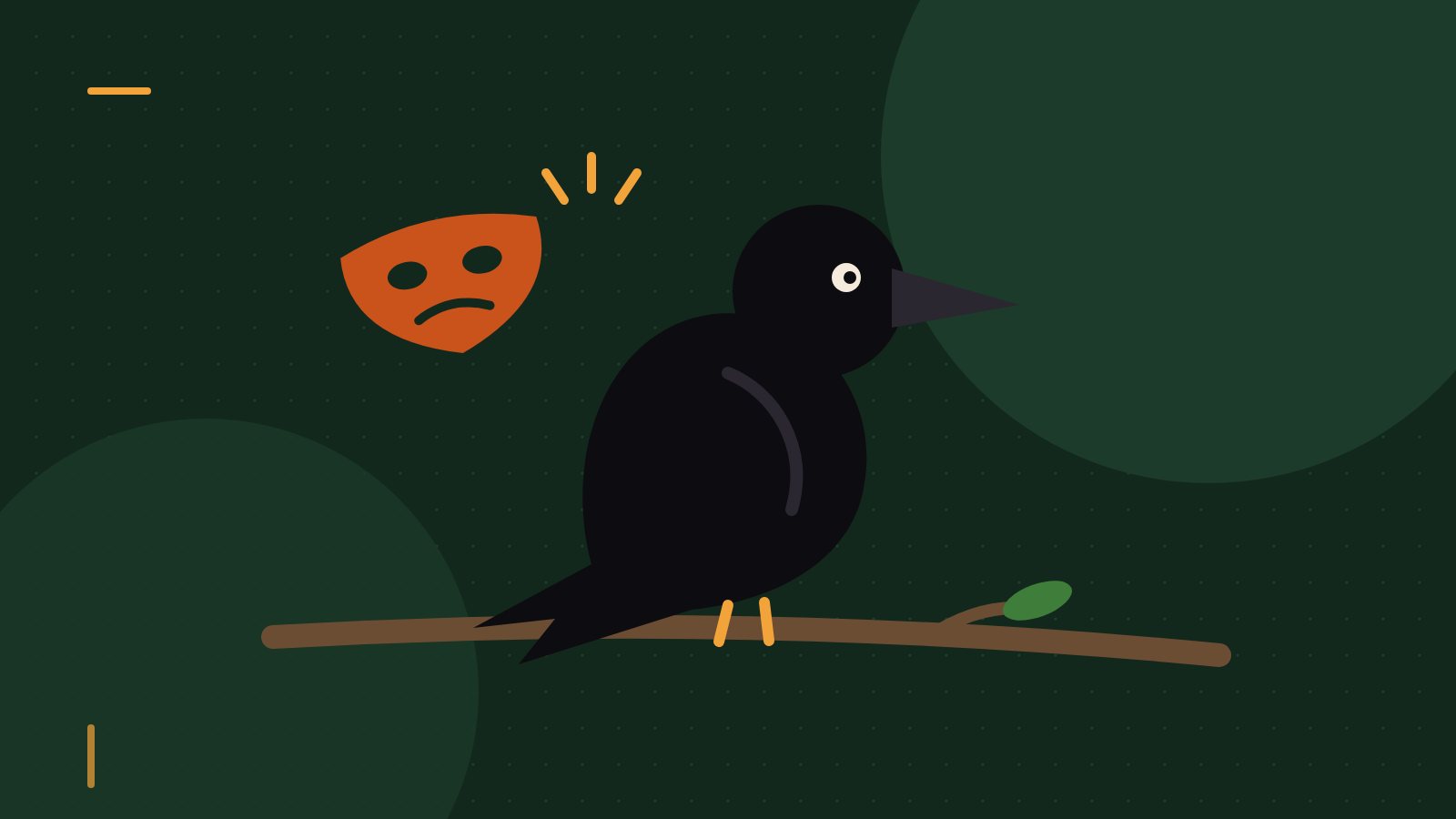
Walk across parts of the University of Washington campus in Seattle wearing a particular rubber mask, and you may get an unpleasant welcome. Crows will gather in the trees above you, calling harshly. Some will dive close. The noise attracts more crows, and soon you are the centre of an angry, cawing crowd.
Take the mask off, and nothing happens. Wear a different mask, and the crows ignore you. It is not people in general they object to. It is that face.
The mask belongs to an experiment that began in 2006, led by the wildlife biologist John Marzluff. It has become one of the most famous demonstrations of something that people who live near crows have long suspected: these birds know exactly who you are.
The caveman experiment
Marzluff and his colleagues wanted to know whether wild crows could recognise individual humans. So they bought a rubber caveman mask. Researchers wearing it trapped a handful of crows on campus, put identification bands on their legs and released them unharmed. Being caught in a net is frightening for a bird, and the crows did not forget.
Afterwards, volunteers walked set routes around the campus. Sometimes they wore the "dangerous" caveman mask. Sometimes they wore a "neutral" mask that had never been involved in trapping. For that control, the team used a mask of the then US vice-president, Dick Cheney, a face that had never been involved in trapping anything.
The results were dramatic. Crows scolded and mobbed the caveman mask, but largely ignored the neutral one, regardless of who was wearing which. It didn't matter which volunteer was wearing it. The birds were reacting to the face, not to the person underneath.
A grudge that spread
The more remarkable finding came with time. Over the following years, the number of crows scolding the caveman mask did not fade. It grew. Crows that had never been trapped, and had never seen the original capture, joined in. Young crows hatched after the trapping took place learned to scold the mask too.
In other words, the crows were passing on information. When an experienced bird screamed at the masked face, others nearby learned that this face meant danger. The knowledge spread through the population socially, much as a warning might spread through a human neighbourhood. Marzluff and his colleagues published the long-term results in 2010 in the journal Animal Behaviour, showing that the recognition lasted for years.
Later work by the same group used brain imaging to look at what happens inside a crow's head when it sees a threatening face. The scans pointed to activity in regions associated with fear and learning, broadly similar to how mammal brains process threats. The details differ, but the logic is familiar: a dangerous face is filed away as something to remember.
Crow "funerals"
Crows don't only learn from dangerous humans. They also seem to learn from death. When a crow finds a dead crow, it often calls loudly, and others gather around. Some people describe these gatherings as funerals.
The ecologist Kaeli Swift, also working at the University of Washington, studied this behaviour in a series of experiments. She found that crows reacted strongly to the sight of a dead crow, especially when a person or a predator was standing near it. In later encounters, the birds were more wary of that person or that place. The "funeral" seems to be less about grief, at least as we understand it, and more about gathering information: what killed this bird, and how can the rest of us avoid the same fate?
Gifts from the sky
If crows can hold grudges, can they also show gratitude? A story from Seattle captured the public imagination in 2015. A young girl named Gabi Mann had been feeding the crows in her garden for years. The crows began leaving small objects behind: buttons, bits of glass, beads, earrings, a piece of a toy. She kept them in a collection, carefully labelled.
Scientists are cautious about interpreting gifts. It is hard to know whether a crow is deliberately repaying a kindness or simply dropping objects where food appears. But the case fits a wider pattern. Crows form relationships with particular people who feed them reliably, and they behave differently towards those people than towards strangers.
A brain built for problem-solving
Crows belong to the corvid family, which also includes ravens, rooks, jays and magpies. Corvids have large brains relative to their body size, and they consistently perform well on tests of problem-solving.
The New Caledonian crow, from a group of islands in the South Pacific, makes and uses tools in the wild, shaping twigs and leaves into hooks and probes to extract insects from wood. In a well-known study from the University of Oxford in the early 2000s, a captive New Caledonian crow named Betty bent a straight piece of wire into a hook to lift a small bucket of food out of a tube.
Other experiments have tested corvids with a puzzle based on Aesop's fable of the thirsty crow, who drops stones into a pitcher to raise the water level. Rooks and New Caledonian crows have solved versions of this task, dropping objects into a tube of water to bring a floating treat within reach, and some learned to choose heavy objects that sink over light ones that float.
None of this means crows think like people. Their intelligence evolved for their own needs: finding food in a changing environment, navigating complex social groups and avoiding predators. Recognising which humans are a threat is just one more application of a mind that is constantly paying attention.
How to get along with your local crows
If you live near crows, the research offers some practical lessons.
They are watching. Crows that live in towns and cities pay close attention to the people around them. If you harass them, they may remember it, and they may tell others.
Kindness is noticed too. Many people who feed crows a little healthy food, such as unsalted peanuts, report that the birds come to recognise them and approach more confidently. Check local rules first, as some areas discourage feeding wild birds.
Nesting season is different. In spring, crows defending their nests may swoop at people who walk too close. It is not personal at first, but it can become personal if they decide you are a repeat threat. Giving nests a wide berth for a few weeks avoids most trouble.
Why it matters
The crow studies are a reminder that intelligence in the animal world is not a ladder with humans at the top and everyone else below. It comes in different shapes. A crow cannot write a poem, but it can recognise your face among thousands, remember what you did years ago and teach its friends and children to treat you accordingly.
That last part might be the most humbling. In a sense, every crow on that Seattle campus is carrying a small piece of history about one rubber mask. The birds who learned it first are long gone. The grudge, it seems, outlived them.